
In This Article
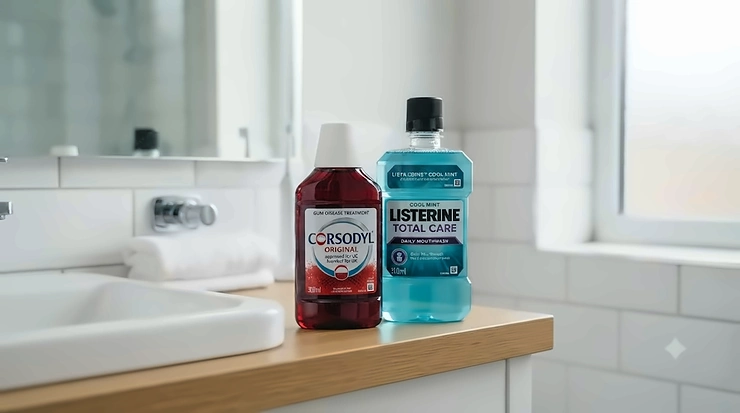
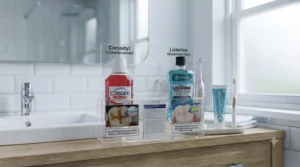
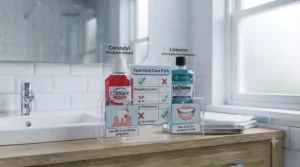
Stand in the mouthwash aisle at Boots for more than thirty seconds and you’ll start to feel a bit persecuted. Corsodyl’s angry red bottle glares at you from one shelf. Listerine’s blue and gold lineup takes up an entire bay on its own. Somewhere in between sits a confusing cast of CPC rinses, zinc formulas and “gum health” claims that all sound suspiciously similar. Corsodyl mouthwash vs Listerine isn’t really a fair fight, though — because they’re not always trying to do the same job.
Corsodyl is built around chlorhexidine digluconate, a prescription-grade antiseptic that dentists have relied on for decades to calm down inflamed, bleeding gums fast. Listerine’s flagship formulas lean on essential oils, cetylpyridinium chloride (CPC) or newer antimicrobial agents, and they’re generally pitched at everyday maintenance rather than short, sharp treatment. Neither is universally “better” — the right pick depends on whether your dentist has flagged gingivitis, how much staining you’re willing to tolerate, and whether you want a daily habit or a two-to-four-week course.
What is Corsodyl mouthwash vs Listerine, in one line? Corsodyl is a short-term chlorhexidine treatment for early gum disease, while Listerine is a broader family of daily-use antibacterial mouthwashes with several dedicated gum-health variants. Gum disease is far more common than most of us admit — the NHS notes that many adults in the UK experience it to some degree, and it’s reversible if caught early. This guide breaks down seven real, currently available UK mouthwashes — spanning both brands plus a couple of worthwhile alternatives — so you can match the right formula to your actual gum situation rather than whichever bottle has the loudest packaging.
Quick Comparison: Corsodyl vs Listerine at a Glance
Before diving into all seven products, here’s the headline difference between the two big names and the wider chlorhexidine mouthwash category they sit within.
| Mouthwash | Active Ingredient | Alcohol Content | Typical Use | Best For |
|---|---|---|---|---|
| Corsodyl Original | Chlorhexidine digluconate 0.2% | Alcohol-free version available | Short intensive course (2–4 weeks) | Diagnosed gingivitis, post-surgery healing |
| Corsodyl Daily Gum Care | Chlorhexidine digluconate 0.06% | Alcohol-free | Everyday maintenance | Ongoing gum protection without harsh treatment strength |
| Listerine Advanced Defence Gum Treatment | Ethyl Lauroyl Arginate (LAE) | Zero alcohol | Gum treatment, 2+ weeks | Bleeding gums wanting a non-chlorhexidine option |
| Listerine Total Care Mild | Essential oils, fluoride | Alcohol-free | Daily all-rounder | Budget-conscious daily users |
Looking at the table, the split is fairly clean: reach for Corsodyl when a dentist has actually mentioned gingivitis or you can see bleeding when you brush, and lean towards Listerine‘s daily ranges when your gums are basically fine and you just want to keep them that way. The alcohol-free trend across all four rows isn’t a coincidence either — most modern gum-focused formulas have quietly dropped alcohol because it tends to dry out already-irritated tissue, which is the last thing inflamed gums need.
💬 Just one click — help others make better buying decisions too!😊
Top 7 Mouthwash for Gingivitis & Gum Health: Expert Analysis
We’ve picked seven real, currently listed UK products spanning chlorhexidine, CPC and essential-oil formulas, at budget, mid-range and premium price points. Every product below keeps its name in bold throughout so you can scan back to it easily.
1. Corsodyl Original Mouthwash — the chlorhexidine mouthwash gold standard
Corsodyl Original Mouthwash is the one most dentists actually reach for when they say the word “mouthwash” to a patient with bleeding gums. The active ingredient, chlorhexidine digluconate 0.2%, is an antiseptic that binds to the tissues in your mouth and keeps working for hours rather than rinsing away in seconds. In practice that means it doesn’t just dilute plaque bacteria, it forms a protective layer that keeps re-colonising bacteria down between rinses — reviewers and clinical summaries consistently cite a protective effect lasting up to twelve hours per dose. Based on the spec comparison with every other product on this list, nothing here works faster on inflamed gum tissue; it’s formulated specifically for short, intensive courses rather than indefinite daily use.
Who’s it for? Anyone who’s been told by a dentist or hygienist that they have gingivitis, anyone healing after periodontal treatment, or anyone dealing with mouth ulcers or denture sore mouth. It’s not really designed for someone with healthy gums who just wants fresher breath — that’s overkill, and honestly a waste of a fairly potent medicated product. Aggregated review sentiment across UK retailers is remarkably consistent: buyers report a noticeable reduction in gum bleeding within a week or two, alongside a strong, slightly bitter aniseed-adjacent taste that takes some getting used to. The most commonly repeated complaint, by a wide margin, is tooth and tongue staining with continued use — a well-documented, reversible side effect rather than a rare fluke.
Pros:
- ✅ Clinically the strongest chlorhexidine mouthwash option here
- ✅ Fast action on bleeding, inflamed gums
- ✅ Alcohol-free version widely available
Cons:
- ❌ Noticeable temporary staining with regular use
- ❌ Not intended for continuous long-term daily use
Expect to pay somewhere in the £4–£7 range for a 300ml bottle at the time of research, rising toward the mid-£teens for the larger 600ml size — always check current price, as retailers shift these often. For a genuine gum problem, this is hard to beat on value: a one-month course rarely costs more than a couple of coffees.
2. Corsodyl Daily Gum Care Mouthwash — same brand, gentler everyday formula
Corsodyl Daily Gum Care Mouthwash takes the trusted Corsodyl name and dials the chlorhexidine concentration right down to 0.06%, paired with fluoride, so it’s built for ongoing use rather than a short treatment window. What this means in practice is you get some of the antibacterial shield effect of the Original formula, but at a strength gentle enough to use twice daily indefinitely without the aggressive staining risk that comes with the 0.2% version. It’s essentially Corsodyl’s answer to “what do I use after my intensive course finishes?”
The fluoride content matters more than it might seem — 250ppm gives a genuine cavity-prevention benefit that the pure treatment formula doesn’t prioritise. Based on the spec comparison, this sits in an interesting middle ground: stronger than a cosmetic Listerine rinse, gentler than Corsodyl Original. Reviewers frequently describe it as the product they switch to once their dentist has confirmed their gums have settled down, using it as ongoing insurance rather than active treatment. A recurring theme in aggregated feedback is that the mint flavour is noticeably more palatable than Original’s medicinal aniseed edge, which genuinely helps people stick with it.
Pros:
- ✅ Gentle enough for genuine everyday use
- ✅ Contains fluoride for cavity protection
- ✅ More palatable mint taste than Original
Cons:
- ❌ Weaker chlorhexidine dose won’t tackle active gingivitis fast
- ❌ Still carries some staining risk over months of use
At around £5–£8 for a 500ml bottle, it works out cheaper per day than the intensive formula simply because a bottle lasts longer at daily-maintenance dosing. If your gums are stable and you want a mid-strength daily habit, this is the sensible pick over the full-strength original.
3. Listerine Advanced Defence Gum Treatment — the chlorhexidine-free gum treatment
Listerine Advanced Defence Gum Treatment takes a genuinely different chemical approach to the gingivitis problem. Instead of chlorhexidine, its active ingredient is Ethyl Lauroyl Arginate (LAE) at 0.147%, which works by creating what the brand describes as an invisible protective shield that stops plaque germs attaching to tooth and gum surfaces in the first place, rather than simply killing bacteria on contact. What most buyers overlook about this model is that it’s specifically marketed as not causing the staining associated with chlorhexidine-based rinses, which is arguably its single biggest selling point against Corsodyl.
Clinically, the brand cites results within two weeks for treating gingivitis, with a stated aim of preventing it from recurring when used consistently. This positions it as a genuine like-for-like alternative to Corsodyl Original for people who’ve been burned (figuratively) by tooth discolouration before but still need an active treatment product rather than a maintenance one. Aggregated UK reviews are broadly positive, with several buyers specifically comparing it favourably to chlorhexidine rinses on staining grounds, though a handful mention the taste is stronger than they expected for a “gentle” gum treatment.
Pros:
- ✅ Treats gingivitis without chlorhexidine’s staining reputation
- ✅ Zero alcohol formula
- ✅ Clinically positioned results within two weeks
Cons:
- ❌ Not suitable for children under 12
- ❌ Some reviewers find the taste stronger than expected
Prices for the 500ml bottle typically sit in the £4–£7 range, similar to Corsodyl, making this a straightforward swap-in rather than a premium upgrade. If staining is your dealbreaker, this is the most credible alternative on this entire list.
4. Listerine Total Care Mild Taste (Alcohol Free) — the everyday all-rounder
Listerine Total Care Mild Taste (Alcohol Free) isn’t a targeted gum-disease treatment — it’s Listerine’s mainstream daily mouthwash, and it earns its spot here as the sensible baseline against which the more medicated options should be judged. The formula combines fluoride with essential oils including eucalyptol, thymol and menthol, delivering what the brand calls “6-in-1” benefits: plaque reduction, gum health support, breath freshening, enamel strengthening, tooth whitening maintenance and cavity protection, all in one alcohol-free rinse.
Here’s what the spec sheet won’t tell you outright: this is a genuinely different category of product to Corsodyl or the Listerine Advanced Defence line. It’s not going to reverse an active case of gingivitis the way a 0.2% chlorhexidine rinse will. What it is very good at is being the mouthwash you use every single day without thinking about it, as part of a routine that also includes proper brushing and flossing. Reviewers consistently describe it as milder and more pleasant to use twice daily than the original “burn your mouth” classic Listerine formula many people remember from childhood, while UK sales data cited by the brand backs up its position as the country’s best-selling mouthwash brand overall.
Pros:
- ✅ Genuinely pleasant for twice-daily long-term use
- ✅ 6-in-1 benefits cover more than gum health alone
- ✅ Widely available and competitively priced
Cons:
- ❌ Not strong enough for active gum disease treatment
- ❌ Some flavour variants still contain alcohol, so check the label
Typically priced under £5 for a 500ml bottle, this is the budget entry point on this list. For healthy gums and general maintenance, it’s excellent value; for diagnosed gingivitis, treat it as a follow-on product rather than a first-line fix.
5. CB12 Mint Mouthwash — the specialist breath and gum combination
CB12 Mint Mouthwash takes a noticeably different formulation route: its patented active combination is zinc acetate paired with a low-dose chlorhexidine diacetate, developed specifically to neutralise the volatile sulphur compounds that cause bad breath rather than simply masking odour with mint flavouring. Sodium fluoride is included too, so there’s a genuine enamel-protection benefit layered on top of the breath-focused core.
What most buyers overlook about this one is that it’s dentist-developed with a fairly narrow original mission — persistent bad breath, or halitosis, which is a genuinely different (if often overlapping) problem to gingivitis. Reviewers consistently and enthusiastically praise the duration of the freshness effect, with “12 hours” being the most repeated phrase in aggregated feedback, and several long-term users specifically mention it working where other mouthwashes had failed them on chronic breath issues. On the downside, it’s a niche, smaller-format product, and buyers occasionally note that ingredient lists vary slightly between retailer listings — worth double-checking the actual bottle you receive if a chlorhexidine-free option matters to you specifically.
Pros:
- ✅ Specifically engineered for stubborn bad breath
- ✅ Contains fluoride for enamel protection
- ✅ Long-lasting effect reported consistently in reviews
Cons:
- ❌ Smaller 250ml bottle means a higher cost per use
- ❌ Narrower focus than a general gum-health rinse
At roughly £5–£9 for 250ml, it’s the priciest option here on a per-millilitre basis, which is the trade-off for a more specialised formula. If breath confidence is your actual pain point rather than bleeding gums specifically, this earns its premium price.
6. Dentyl Dual Action CPC Mouthwash — the visibly satisfying plaque remover
Dentyl Dual Action CPC Mouthwash is built around a genuinely distinctive two-phase formulation: an oil phase containing isopropyl myristate (IPM) and a water phase containing cetylpyridinium chloride (CPC), which combine when you shake the bottle. The practical upshot, and the reason this product has a small cult following, is that you can visibly see plaque and food debris left behind in the sink after rinsing — an oddly satisfying (if slightly gross) confirmation that it’s actually doing something.
Key specs with real-world meaning: the brand cites a clinical study showing plaque reduction of around 35% within twelve hours rising to roughly 60% after 28 days of twice-daily use, which is a meaningfully strong claim for an over-the-counter product that isn’t chlorhexidine-based. Reviewers consistently note the visual “wow factor” as their favourite feature, alongside genuine appreciation for the alcohol-free formula not stinging sensitive gums. A common complaint in user reviews is that the strong flavour combinations (clove, icy cherry) are polarising — people either love the novelty or find them a bit much for a twice-daily habit.
Pros:
- ✅ Visible plaque removal builds user confidence
- ✅ Strong published plaque-reduction figures
- ✅ Alcohol-free and gentle on sensitive gums
Cons:
- ❌ Distinctive flavours won’t suit everyone
- ❌ Requires shaking before every use, which some find fiddly
A 500ml bottle typically runs in the £4–£6 range, putting it firmly in budget-to-mid territory. For plaque-conscious buyers who want visual feedback, this is genuinely good value.
7. Dentyl Active Mouthwash Plaque Fighter — the entry-level CPC option
Dentyl Active Mouthwash Plaque Fighter is the simpler, single-phase sibling to Dual Action, built around cetylpyridinium chloride as its sole active antibacterial ingredient rather than the dual-phase system. It’s alcohol-free, contains fluoride, and is pitched squarely at long-lasting fresh breath alongside general plaque control, rather than active gum-disease treatment.
Key specs with real-world meaning: CPC is a well-established antimicrobial agent that’s gentler and generally less staining than chlorhexidine, which is exactly why it turns up across the budget end of the gum-health market from multiple brands. This makes it a sensible entry point for someone who wants more than a purely cosmetic rinse but isn’t dealing with a diagnosed gum condition that needs Corsodyl-level intervention. Aggregated reviewer sentiment is solid rather than spectacular — people generally find it does the basics well, with the alcohol-free formula being consistently praised for not causing the burning sensation associated with older-style mouthwashes, though it lacks the dramatic “science experiment in the sink” effect of its Dual Action sibling.
Pros:
- ✅ Simple, no-fuss CPC formula
- ✅ Genuinely gentle, non-stinging alcohol-free rinse
- ✅ Budget-friendly everyday option
Cons:
- ❌ Less dramatic results than Dual Action or chlorhexidine options
- ❌ Not suitable for active gum disease treatment
Expect to pay under £5 for a 500ml bottle at the time of research. As the most budget-friendly product on this whole list, it’s a perfectly reasonable everyday choice provided your gums don’t need anything stronger.
How to Use Gum-Health Mouthwash Properly (Setup, Timing & Common Mistakes)
Buying the right bottle is only half the job — how you actually use it changes the results dramatically, and this is where Amazon listings tend to go quiet. First, timing matters more than most people realise: rinsing with a chlorhexidine mouthwash like Corsodyl immediately after brushing with standard toothpaste can partially neutralise the active ingredient, because most toothpastes contain sodium lauryl sulphate, which interacts poorly with chlorhexidine. The fix is simple — leave a gap of at least thirty minutes between brushing and rinsing, or rinse first thing before brushing instead.
Second, measure properly rather than eyeballing it. Corsodyl’s dosing is 10ml (roughly two teaspoons) swished for a full minute, while Listerine products typically call for 20ml swished for thirty seconds — under-dosing is one of the most common reasons people report “it didn’t work for me” in reviews. Third, don’t swallow, and don’t rinse your mouth with water immediately afterwards, since that washes away the protective film the active ingredient has just formed. Common first-month mistakes include stopping too early (chlorhexidine treatment courses need the full two-to-four weeks to show their effect on bleeding), and combining Corsodyl with an SLS-based toothpaste at the same sitting, which quietly undermines the whole point of using it.
Real-World Scenarios: Which Mouthwash Matches Your Situation
Case studies help here more than another spec table, so let’s walk through three genuinely common buyer profiles. Meet the recently diagnosed patient: a 34-year-old who’s just been told at a check-up that their gums bleed because of early gingivitis, uses an electric toothbrush twice daily but skips flossing most days, and wants results fast. For this profile, Corsodyl Original for a strict two-to-four-week course, paired finally with committing to interdental brushes, is the clear move — the concentrated chlorhexidine dose is specifically designed for exactly this bleeding-gums scenario, and the staining risk is a short-term trade-off most people accept once told it’s reversible.
Meet the maintenance-focused parent: someone whose gums are healthy but who’s watched a partner deal with gum disease and wants to stay ahead of it, using the mouthwash as insurance rather than treatment. Listerine Total Care Mild or Corsodyl Daily Gum Care both fit here — gentle enough for years of daily use, without the staining risk of the full-strength treatment formula. Meet the breath-anxious commuter: someone whose gums are fine but who’s self-conscious about persistent bad breath despite good brushing habits, often after ruling out other causes with a dentist. CB12 Mint is purpose-built for exactly this problem, tackling the sulphur compounds directly rather than just masking them with mint for twenty minutes.
Corsodyl vs Listerine: How to Choose the Right One
- Get a diagnosis first. Don’t self-prescribe chlorhexidine treatment on a hunch — if your gums bleed regularly when you brush, see a dentist or hygienist before reaching for Corsodyl Original, since the treatment strength is meant for a confirmed, short-term problem.
- Weigh staining against strength. Chlorhexidine is the most clinically proven active ingredient here, but it’s also the one most likely to leave visible staining; if that’s a dealbreaker, Listerine Advanced Defence Gum Treatment‘s LAE-based formula is the closest genuine alternative.
- Match the concentration to the duration you’ll use it. Full-strength 0.2% formulas are for short courses; anything you plan to use for months on end should be a gentler daily formula like Corsodyl Daily Gum Care or a mainstream Listerine rinse.
- Check the alcohol content. Alcohol-free formulas are gentler on already-irritated gum tissue and less likely to cause a stinging sensation, which matters most if your gums are already inflamed.
- Consider your actual problem. Bleeding gums, chronic bad breath and general plaque build-up genuinely call for different formulas — don’t assume the strongest product is automatically the best fit.
- Factor in taste tolerance. A mouthwash you dislike using is one you’ll quietly abandon after a week; reviewers repeatedly cite taste as the reason for switching products, regardless of clinical strength.
- Budget for the full course, not just the bottle. A genuine gingivitis treatment needs the full recommended duration to work, so price per course matters more than price per bottle.
Common Mistakes When Buying Mouthwash for Gingivitis
The single biggest mistake is buying a cosmetic, alcohol-heavy mouthwash and expecting it to treat diagnosed gum disease — a fresh-breath rinse and a chlorhexidine mouthwash are simply not interchangeable, however similar the bottles look on a shelf. A close second is stopping a Corsodyl-style treatment course the moment bleeding improves rather than completing the full two-to-four weeks, which risks the inflammation creeping back before it’s genuinely resolved. Buyers also frequently overlook the alcohol-free label entirely, then wonder why a rinse stings when their gums are already sore — checking this single line on the packaging avoids a lot of discomfort.
Another recurring pitfall is assuming price reflects strength: some premium-priced niche mouthwashes are actually gentler daily formulas, while some of the cheapest bottles on this list contain genuinely potent active ingredients. Finally, plenty of buyers treat mouthwash as a replacement for flossing or interdental brushes rather than an addition to them — no rinse, however well-formulated, physically removes plaque wedged between teeth the way mechanical cleaning does.
Chlorhexidine Mouthwash vs CPC Mouthwash: What’s the Real Difference?
This is the comparison that actually matters more than “Corsodyl vs Listerine” as a brand rivalry, because both brands make products in both categories. Chlorhexidine digluconate, the active ingredient in Corsodyl, is widely regarded in dental research as the most clinically effective over-the-counter antiplaque agent available without a prescription — a National Institute for Health and Care Research evidence review confirmed it meaningfully reduces plaque in people with mild gum disease, while flagging staining as its main trade-off. Cetylpyridinium chloride, used in Dentyl‘s range and several Listerine variants, is a gentler quaternary ammonium antiseptic that’s less staining and better tolerated for continuous long-term use, but generally regarded as less potent against an active flare-up of gingivitis.
| Factor | Chlorhexidine (Corsodyl) | CPC (Dentyl, some Listerine) |
|---|---|---|
| Plaque-fighting strength | Very high | Moderate |
| Staining risk | Higher | Lower |
| Recommended duration | Short courses (2–4 weeks) | Ongoing daily use |
| Taste | Stronger, medicinal | Milder, more variety |
| Best For | Diagnosed gingivitis needing fast results | Long-term maintenance and prevention |
Reading the table, the honest takeaway is that chlorhexidine wins on raw clinical power and CPC wins on everyday liveability. Neither is objectively “the best mouthwash” — they’re tools for different stages of gum health, and a lot of dentists will actually recommend both, sequentially, over the course of a year: chlorhexidine to knock down an active problem, CPC or a mainstream rinse to keep it from coming back.
What to Expect: Real-World Performance in the First Month
Specs on a bottle don’t tell you what week one actually feels like, so here’s the honest transformation from label to lived experience. With Corsodyl Original, expect a strong, slightly bitter taste on day one that most people describe as needing two or three uses to stop noticing — this isn’t a flaw, it’s simply what a working antiseptic tastes like. By roughly day seven to ten of twice-daily use, aggregated reviewer feedback consistently reports a noticeable drop in bleeding when brushing, which lines up with clinical timelines for gingivitis improvement. Staining, if it happens, tends to show up gradually over the second and third week rather than immediately, appearing as a slightly yellow-brown tint most visible along the gumline and between teeth.
With a CPC-based Listerine or Dentyl product, the experience is gentler and less dramatic in both directions — no burning, no obvious staining, but also a slower, subtler improvement curve for anyone actually dealing with inflamed gums rather than simple maintenance. For breath-focused products like CB12, the effect is felt almost immediately and consistently, which is exactly the kind of instant feedback loop that keeps people using it long-term. Across the board, the biggest factor separating satisfied and disappointed reviewers isn’t the product itself — it’s whether people used the correct dose, for the correct duration, alongside (not instead of) brushing and flossing.

Tooth Staining and Safety: What You Need to Know
Tooth staining deserves its own honest section because it’s the single most repeated concern in reviews of chlorhexidine mouthwash, and it’s worth understanding rather than fearing. The staining happens because chlorhexidine binds to tooth surfaces and reacts with tannins in everyday foods and drinks like tea, coffee and red wine, producing a visible brown or yellow tint. Crucially, this is extrinsic staining — sitting on the surface of the enamel rather than inside the tooth — which means it’s reversible with a routine scale and polish at your dentist or hygienist, not permanent damage to the tooth itself.
A few practical habits reduce the risk significantly: use the product for the recommended treatment window rather than indefinitely, rinse well after coffee or red wine where practical, and don’t use a whitening toothpaste alongside a chlorhexidine rinse expecting it to cancel the effect out — the mechanisms don’t really interact that way. On the regulatory side, Corsodyl and Listerine’s medicated formulas are classified and sold in the UK as cosmetic or medicinal products depending on their claims, and government guidance backs chlorhexidine’s short-term use for gum disease specifically as part of the wider national oral health prevention toolkit. If you notice ulceration, swelling, or a rash rather than simple discolouration, stop use and speak to a pharmacist or dentist, since that’s a different and much rarer reaction pattern.
Long-Term Cost & Maintenance: What a Year of Gum Care Actually Costs
Thinking in cost-per-bottle misses the bigger picture, so let’s talk total cost of ownership instead. A typical gingivitis flare-up might need one 300ml bottle of Corsodyl Original for a four-week course, working out to a genuinely modest one-off spend given how the alternative — untreated gum disease progressing toward periodontitis — carries far higher long-term costs in dental treatment. After that course, switching to a 500ml bottle of Corsodyl Daily Gum Care or Listerine Total Care Mild for ongoing maintenance, replaced roughly every six to eight weeks with twice-daily use, keeps annual spend fairly predictable and modest compared to most other health and beauty routines.
Where the real long-term value shows up is in what mouthwash prevents rather than what it costs directly: the NHS is clear that gum disease left untreated is a major cause of adult tooth loss, and professional periodontal treatment down the line is a far bigger expense than a bottle of mouthwash ever will be. Buying the cheapest possible product without matching it to your actual gum condition is a false economy if it means a genuine problem goes unaddressed for months.
Listerine Gum Health Review: What UK Reviewers Actually Say
Pulling together aggregated sentiment specifically from UK buyers of Listerine’s gum-focused range paints a consistent picture rather than a scattered one. On Listerine Advanced Defence Gum Treatment, the most repeated praise point is the absence of the staining people associate with chlorhexidine, alongside genuine reports of reduced bleeding within the brand’s stated two-week window. A recurring theme in reviews is that people who’d previously tried and disliked Corsodyl for its taste or staining specifically sought this out as a direct swap, and were satisfied with the trade-off of slightly less aggressive short-term power for a more tolerable everyday experience.
On the milder Listerine Total Care line, sentiment is positive but framed differently — people rarely mention gum disease specifically, and instead praise it as a reliable, inoffensive daily habit that “does what it says” without drama. The most common criticism across the whole Listerine gum-health range, echoed in aggregated feedback, is that classic full-strength Listerine variants (not covered in this guide’s top seven) still carry a reputation for a harsh, burning sensation that alcohol-free reformulations have specifically been designed to fix — worth checking the label carefully, since older-style and newer alcohol-free bottles can sit side by side on the same shelf.
Frequently Asked Questions
❓ Is Corsodyl better than Listerine for gum disease?
❓ Does Corsodyl stain teeth permanently?
❓ Can I use Corsodyl and Listerine together?
❓ Is alcohol-free mouthwash better for gum disease?
❓ How long does it take for chlorhexidine mouthwash to work on gingivitis?
Conclusion
There’s no single winner in Corsodyl mouthwash vs Listerine, because they’re not always competing for the same job. When gums are actively bleeding and a dentist has flagged gingivitis, Corsodyl Original‘s chlorhexidine strength is the most clinically backed short-term fix on this list, staining risk and all. When the priority is gentler daily maintenance, both Corsodyl Daily Gum Care and Listerine Total Care Mild do that job well without the trade-offs of full-strength treatment. And if staining specifically is the dealbreaker, Listerine Advanced Defence Gum Treatment offers a genuinely credible chlorhexidine-free path to the same result.
The wider seven-product spread here — pulling in CB12‘s breath-focused formula and both Dentyl CPC options — exists because gum health, bad breath and plaque control are related but distinct problems, and treating them as one undifferentiated “mouthwash” purchase is where most people go wrong. Match the formula to the actual issue, use it at the correct dose for the correct duration, and treat mouthwash as one part of a routine that still includes proper brushing and interdental cleaning — not a replacement for either.
Recommended for You
- Toothpaste for Gingivitis: 7 UK Picks That Actually Work (2026)
- 7 Best Gingivitis Toothpaste Under £10 (2026 UK Guide)
- 7 Best Dental Filling Repair Kits for UK Emergencies (2026)
Disclaimer: This article contains affiliate links. As an Amazon Associate, I earn from qualifying purchases. If you purchase products through these links, we may earn a small commission at no additional cost to you.
✨ Found this helpful? Share it with your friends! 💬🤗
