
In This Article
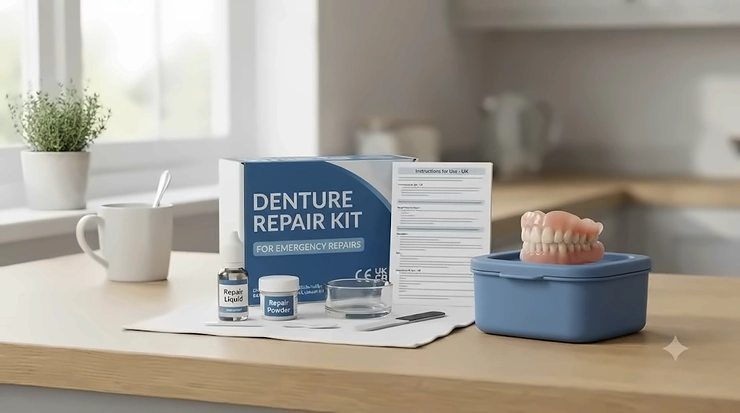
It always happens at the worst possible time. You’re mid-sentence at a dinner party, or halfway through your morning toast, and you feel that horrible little crunch. A denture repair kit is the small box of dental-grade resin, beads or bonding paste that sits in a bathroom cabinet for exactly this moment — the emergency toolkit that gets you through a weekend, a work trip, or a bank holiday when your dentist’s answerphone is the only thing picking up. Sold in pharmacies and on amazon.co.uk for a few pounds, these kits promise a fast, temporary fix for cracked plates, loose teeth and lost fillings.
We’re not going to pretend a tube of resin can replace a dental technician, because it can’t, and anyone telling you otherwise is selling something. What we will do is walk you through seven real products currently available to UK buyers, explain honestly what each one is (and isn’t) good for, and give you the safety context that most listings conveniently leave out. This matters more than it sounds: dentures are a functional appliance sitting against your gums and, in some cases, close to your airway, so what you put on them isn’t a trivial choice — a point the Oral Health Foundation’s denture care guidance makes clear when it comes to handling and hygiene generally.
Whether you’re searching because your denture just snapped in your hand, because you want to know how to repair a broken denture at home before your next dental appointment, or because you’re simply stocking a sensible emergency kit for the future, this guide covers the practical, the comparative and the genuinely useful. Prices below are shown as ranges rather than fixed figures, since they shift week to week — always check the current price on the product page before buying.
Quick Comparison Table
| Product | Best For | Price Range | Repair Type |
|---|---|---|---|
| Dentemp Repair-It Advanced Formula Denture Repair Kit | Budget emergency fixes | around £8-£12 | Resin bonding |
| DenTek Temparin Max Home Dental Repair Kit | Lost fillings & loose crowns | around £4-£9 | Thermoplastic filler |
| Life Healthcare Temporary Tooth Filling Kit | No-mixing, UK-made simplicity | around £6-£9 | Ready-to-use filler |
| HICAPA Temporary Tooth Repair Kit | Budget-conscious first-timers | around £7-£10 | Food-grade silicone |
| WERPOWER Tooth Filling Repair Kit | Tool-assisted DIY shaping | around £6-£9 | Moldable beads |
| Nadiaen Denture Repair Kit | Loose or gappy partial dentures | around £12-£18 | Snap-on reline |
| Xinshijie Silicone Reline Denture Set | Full upper/lower comfort reline | around £15-£25 | Silicone reline |
Looking at the spread here, the split is really between bonding kits (fixing a break or a chip) and reline kits (refitting a denture that’s gone loose against the gums), and mixing the two up is the single biggest buying mistake we see. Budget doesn’t automatically mean lower quality either — Dentemp Repair-It and DenTek Temparin Max sit at the cheap end but are two of the more established names in this category, while the reline-focused kits like Xinshijie Silicone Reline Denture Set cost more simply because they’re solving a different, more involved problem.
💬 Just one click — help others make better buying decisions too!😊
Top 7 Denture Repair Kits: Expert Analysis
Seven products, three broad jobs — bonding a break, filling a gap, or relining a loose fit — and a lot of variation in how well each one is suited to a specific kind of denture disaster. Here’s the honest breakdown.
1. Dentemp Repair-It Advanced Formula Denture Repair Kit — best-known budget bonding kit
This one keeps popping up as a bestseller on amazon.co.uk, and it’s worth understanding why before you buy it on reputation alone. It’s a two-part system: a powder and a liquid that you mix together into a resin, which you then apply to the broken edge before pressing the pieces back together.
The kit gives you roughly three applications per pack, and includes a small strip of sandpaper for smoothing any rough edges once the resin has cured. In practice, that “three repairs” figure assumes each repair uses a small, controlled amount — attempt a big structural break and you might burn through the whole tube on one fix. Based on the spec comparison with rival resin kits, this is a genuinely fast-setting formula, which is useful when you’re trying to do this over a bathroom sink rather than a dental bench.
Reviewers consistently report mixed results with strength and reliability — some describe the bond as very strong and long-lasting until their dental appointment, while others say it failed within hours or didn’t hold at all. Value for money gets a similarly split verdict: some buyers feel three repairs per pack is decent value, others feel let down when the fix doesn’t last. What most buyers overlook is that success here depends heavily on technique — the resin needs a clean, dry surface and a gap between the broken pieces to key into, so a hairline crack with no gap tends to fail faster than a clean break.
Pros:
- ✅ Fast-setting resin, ready to use within minutes
- ✅ Widely available and consistently one of the cheapest options
- ✅ Includes sandpaper for finishing rough edges
Cons:
- ❌ Real-world holding power is inconsistent across reviewers
- ❌ Only around three applications per pack, easily used up on one bad break
At around £8-£12 for a two-pack, this sits firmly in “cheap insurance” territory — decent value if it works for your specific break, frustrating if it doesn’t.
2. DenTek Temparin Max Home Dental Repair Kit — best for lost fillings and loose crowns
Slightly different job to the Dentemp kit above: this one is built around a thermoplastic material, similar in spirit to the temporary cements dentists themselves use, and it’s aimed more squarely at natural teeth that have lost a filling or a crown that’s come loose, rather than a snapped denture plate.
You scoop a small amount from the vial, roll it into a ball, place it into the crown or onto the tooth, then bite down to set it into position. It begins hardening within minutes but reviewers who’ve actually used it note it benefits from being left overnight to fully solidify — applying it before bed and checking in the morning tends to give a more secure result than expecting an instant fix. One verified buyer noted the applicator tool runs a little long, which made back teeth fiddly to reach, though the material itself held securely enough to eat normally the next day.
Here’s what the spec sheet won’t tell you: this isn’t designed for denture plates at all — it’s a filling and crown-securing product. If your actual problem is a cracked acrylic base rather than a lost filling, this is the wrong tool for the job, however tempting the “denture repair kit” listing category makes it look.
Pros:
- ✅ 12+ repairs per single pack, genuinely good value per use
- ✅ Familiar dental-cement-style material, used in professional settings too
- ✅ Twin packs available for households needing frequent stopgap fixes
Cons:
- ❌ Applicator tool can be awkward for back-of-mouth application
- ❌ Not designed for broken denture plates — fillings and crowns only
Single packs run around £4-£6, with twin packs around £6-£9 — one of the more genuinely affordable options here, provided you’re solving the right problem.
3. Life Healthcare Temporary Tooth Filling Kit — best no-mixing, UK-made option
Made in the UK and built around a ready-to-use format, this kit skips the powder-and-liquid mixing step entirely. You get ten pre-measured fillings designed to be applied directly, which noticeably lowers the room for user error compared with kits that need precise mixing ratios under time pressure.
Ten fillings sounds generous next to Dentemp’s three repairs, but it’s worth being honest about what “a filling” means here — this product is aimed at small cavities and lost fillings rather than reconstructing a broken denture tooth, so the count isn’t directly comparable across product categories. Based on the spec comparison, the appeal is really about convenience and consistency: no mixing means no risk of getting the ratio wrong when you’re stressed and standing at the bathroom mirror at 11pm.
Being manufactured domestically also simplifies the returns and support process for UK buyers, which matters more than it sounds for a product you might need to query. If you can’t verify individual customer review data at the time of research, the honest thing to do is say so rather than invent testimonials — what we can confirm is the product’s UK manufacturing claim and its no-mix format, both of which are genuine points of difference from most of the imported alternatives on this list.
Pros:
- ✅ No mixing required — reduces user error under pressure
- ✅ Ten uses per kit, good for a household emergency stash
- ✅ Manufactured in the UK, simplifying support and returns
Cons:
- ❌ Aimed at small fillings, not structural denture breaks
- ❌ Verified independent review data was limited at the time of research
Priced around £6-£9, it’s a sensible mid-range pick for anyone who wants simplicity over raw bonding strength.
4. HICAPA Temporary Tooth Repair Kit — best budget silicone filler
HICAPA’s kit uses a food-grade silicone filler rather than the acrylic resin found in Dentemp’s formula, which changes the texture and handling considerably — silicone is softer and more forgiving to mould, though it also tends to be less rigid once set, which matters if the repair needs to withstand real chewing force.
At 30g, there’s a reasonable amount of product to work with across multiple attempts, and food-grade silicone is a sensible baseline safety spec for anything going in your mouth, even temporarily. Here’s what most buyers overlook about silicone-based fillers specifically: they’re better suited to gap-filling and cosmetic smoothing than to load-bearing structural repairs, because the material simply doesn’t have the compressive strength of a cured resin.
We weren’t able to verify a substantial body of independent customer reviews for this specific listing at the time of research, so rather than invent sentiment we don’t have, it’s fairer to say this: judged purely on its stated materials and format, it’s a reasonable low-commitment entry point for someone who’s never used a repair kit before and wants to test the process without spending much.
Pros:
- ✅ Food-grade silicone, gentler and easier to mould than resin
- ✅ 30g gives multiple attempts per kit
- ✅ Genuinely low price point for first-time buyers
Cons:
- ❌ Silicone lacks the rigidity needed for structural or load-bearing breaks
- ❌ Independently verified review data was sparse at time of research
Typically priced around £7-£10, this is best thought of as a soft, low-risk starter kit rather than a heavy-duty fix.
5. WERPOWER Tooth Filling Repair Kit — best for tool-assisted shaping
WERPOWER bundles its moldable beads with four dental tools, which is a genuinely useful inclusion — a lot of rival kits assume you already own something suitable for shaping and smoothing, when in reality most bathroom cabinets don’t contain dental spatulas.
The 30ml format uses thermoplastic beads that soften in hot water before being shaped by hand, a method shared by several of the temporary filling and tooth-repair products in this space. On paper, this means more control over the final shape than a straight liquid-resin mix, since you can reposition the material for longer before it fully hardens. The product currently holds a 3.5-out-of-5 aggregate rating across a moderate review pool on Amazon, which places it in solidly average territory rather than a standout — not bad, but not a kit we’d point to as best-in-class either.
What the spec sheet doesn’t convey is how fiddly bead-based products can be for anyone without steady hands or good near vision; the beads need reheating if they cool too fast mid-shaping, which can be genuinely frustrating on a first attempt.
Pros:
- ✅ Includes four dental tools for shaping and application
- ✅ Reheatable beads allow more repositioning time than liquid resin
- ✅ Reasonably priced for a tool-inclusive kit
Cons:
- ❌ Aggregate 3.5-star rating suggests inconsistent user experience
- ❌ Bead reheating can be fiddly without practice
Expect to pay around £6-£9, making this a fair mid-budget pick if the included tools genuinely save you a separate purchase.
6. Nadiaen Denture Repair Kit — best for loose, gappy partial dentures
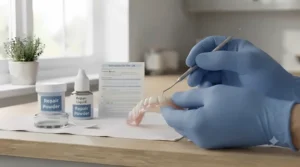
This is where the article shifts from bonding breaks to refitting loose dentures, and Nadiaen’s kit is built specifically for that job. It bundles three pairs of soft, clip-in reline components with thermal beads, aimed at partial dentures that have started to feel loose or gappy against the gum line rather than dentures that have physically snapped.
Reviewers consistently note relining kits like this one work by adding a cushioned layer between the existing denture and the gum, effectively taking up slack that’s developed as gums naturally change shape over time. What most buyers overlook about reline kits generally is that they don’t fix an underlying poor fit caused by bone changes — they buy you comfort and stability for a period, typically a few months, not a permanent correction.
Because this is a snap-on, adjustable system rather than a permanent chairside reline, it suits people managing a temporary gap before a dental appointment, or those wanting a stopgap between professional relines, rather than anyone hoping to avoid the dentist indefinitely.
Pros:
- ✅ Three pairs included, good value for repeated adjustments
- ✅ Soft clip-in design is comfortable against sensitive gums
- ✅ Thermal beads allow reshaping to individual mouth contours
Cons:
- ❌ Temporary fix only — doesn’t address the underlying cause of looseness
- ❌ Independently verified long-term durability data is limited
Priced around £12-£18, it sits in the mid-range and is best suited to partial rather than full dentures.
7. Xinshijie Silicone Reline Denture Set — best premium full-mouth reline
The most comprehensive kit on this list, Xinshijie’s set is designed for both upper and lower dentures and uses a soft silicone reline material rather than a hard acrylic, aiming to reduce pressure points against the gums across the whole arch rather than a single tooth or section.
Soft silicone relines genuinely do change the comfort profile of an ill-fitting denture — the padding compresses slightly under bite pressure instead of transmitting it directly to the gum ridge, which is the mechanism behind most of the “more comfortable” claims you’ll see across this product category. Based on the spec comparison with the smaller Nadiaen kit above, the trade-off for that comfort is price and complexity: full-mouth reline sets take longer to apply correctly and cost noticeably more per unit.
This is genuinely the premium option here, and it’s priced accordingly. If you’re managing full dentures that have become loose across the whole arch rather than a single problem tooth, it’s the more logical fit than a smaller partial reline kit — but it’s overkill, and an unnecessary expense, for a single chipped tooth.
Pros:
- ✅ Covers both upper and lower dentures in one set
- ✅ Soft silicone reduces pressure points versus rigid materials
- ✅ Suited to comprehensive rather than spot fixes
Cons:
- ❌ Highest price point on this list
- ❌ More involved application process than single-tooth repair kits
At around £15-£25, this is an investment piece rather than an impulse buy — reserve it for genuine full-arch looseness.
How to Repair a Broken Denture at Home: A Practical Usage Guide
If you’re dealing with a genuine emergency and need to fix a broken denture at home before you can get to a dentist, the process matters as much as the product. Getting the sequence wrong is one of the most common reasons a home repair fails within hours.
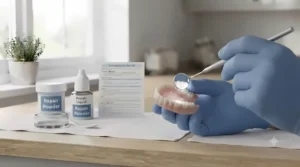
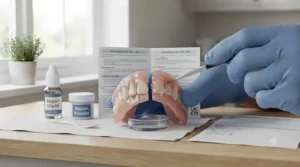
Start by locating every broken piece — if a tooth has come away cleanly, keep it, since most bonding kits work by reattaching the original piece rather than sculpting a replacement from scratch. Rinse the pieces in cool water; never hot, since heat can warp acrylic denture material permanently, and never use your dishwasher or boiling water to “sterilise” broken parts. Dry the broken edges thoroughly, because most resin and bead-based repair materials need a clean, dry surface to bond properly — moisture is one of the biggest causes of a failed fix.
Test-fit the pieces together dry before you mix or apply anything, checking that the break lines up cleanly with no gaps you weren’t expecting. Follow the specific product’s mixing and timing instructions to the letter rather than eyeballing quantities — resin kits in particular set fast once mixed, and rushing the ratio is a common first-attempt mistake. Once applied, hold the pieces together firmly and steadily for the full recommended curing time, resisting the urge to check on it every thirty seconds, since repeated handling before the material has cured is one of the more common ways a repair weakens before it’s even finished setting.
Finally, avoid wearing the repaired denture to eat anything firm for at least the first few hours, and book a dental appointment regardless of how well the home fix seems to be holding — a home repair should buy you days, not become a long-term replacement for a professional fix.
Real-World Scenarios: Who Actually Needs a Denture Repair Kit
Picture three fairly ordinary situations, because “who needs this” is a more useful question than the marketing copy on most listings ever addresses.
Take someone heading off on a two-week holiday abroad, dentures packed alongside the sun cream. If a plate cracks on day four in a country where finding an English-speaking dentist isn’t straightforward, a compact resin kit like Dentemp Repair-It Advanced Formula Denture Repair Kit is the difference between an awkward, self-conscious fortnight and getting through the trip with dignity intact. The priority here isn’t the strongest possible bond — it’s portability and speed.
Then there’s the retiree managing a partial denture that’s felt increasingly loose over the past few months, not broken, just no longer snug. This is a reline situation rather than a bonding one, and something like the Nadiaen Denture Repair Kit buys real comfort while they wait for the next available NHS or private appointment — a genuinely useful stopgap rather than a permanent solution.
Finally, consider a shift worker whose dentist’s opening hours never quite line up with their own schedule, and who’s lost a filling on a Friday evening with the surgery shut until Monday. A fast, tool-assisted kit like WERPOWER Tooth Filling Repair Kit, kept in a bathroom drawer for exactly this scenario, turns a stressful weekend into a manageable one — provided the very next available appointment gets booked, not skipped.
DIY Denture Repair Safety: What You Need to Know
This is the section that most affiliate content quietly skips, and it shouldn’t be skipped, because the risks here are genuinely worth understanding before you reach for a tube of resin.
The single most important safety rule is also the most commonly broken one: never use ordinary household superglue, all-purpose adhesive, or anything not explicitly formulated for oral use. Standard glues weren’t designed to be biocompatible, can release compounds that irritate or damage soft tissue, and often fail unpredictably under the specific, repeated flexing forces a denture experiences during chewing — which is precisely why dedicated repair kits exist and cost more than a tube of superglue from the shed.
Fit matters more than most people expect. A repair that changes the shape of the denture even slightly, even by the thickness of a smoothed edge, can throw off the bite and cause sore spots, ulceration, or uneven pressure on the remaining natural teeth if you have a partial denture. It’s also worth understanding what a home fix can’t do — it can’t detect hairline stress fractures elsewhere in the plate that caused the visible break in the first place, which is exactly why a denture that keeps breaking in roughly the same spot needs a dentist’s assessment rather than another home repair.
There’s a genuine and serious safety consideration around choking too. A cracked or loosely repaired denture is more likely to fragment further in the mouth, and a clinical review of denture-related incidents found adverse outcomes in a significant proportion of cases where fragments were swallowed or inhaled, including some with severe consequences. If your repaired denture ever feels unstable, sharp-edged, or wrong in your mouth, take it out rather than risk wearing it.
The NHS’s official guidance is unambiguous on this point: if your dentures break, you should bring the pieces to your dentist so they can assess whether a proper repair is possible, rather than relying on a home fix indefinitely.
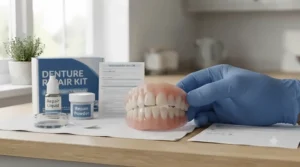
Denture Repair Kit vs Dentist: When to DIY and When to Call a Professional
Every repair kit on this list is explicitly a temporary measure, and understanding where the line sits between a reasonable home fix and a job that needs a dental lab will save you money, discomfort, and possibly a second, worse break.
| Situation | Home Repair Kit | Professional Repair |
|---|---|---|
| Clean single-tooth chip, small area | Reasonable short-term fix | Recommended follow-up regardless |
| Denture split into multiple pieces | Not appropriate | Required |
| Metal clasp or framework damage | Not appropriate | Required |
| Denture feels loose but isn’t broken | Reline kit as a stopgap | Recommended for lasting fit |
| Repeated breaks in the same spot | Not appropriate | Required, likely underlying fit issue |
The pattern in this table isn’t subtle: home kits earn their keep on small, contained, cosmetic damage, and lose their usefulness fast once metal frameworks, multiple fracture lines, or a pattern of repeated breaks enter the picture. A denture that keeps snapping in the same place usually isn’t a bonding problem at all — it’s a sign the underlying fit has changed, and no amount of resin fixes a fit issue.
One point worth being genuinely clear on, because it changes the cost calculation entirely for UK readers: NHS denture repairs are free in England and Northern Ireland, regardless of your usual charge-paying status, with no time limit on how long after the original denture was made. That’s a meaningfully different equation from paying £8-£25 for a home kit that may only buy you a few days — for anyone registered with an NHS dentist, getting an appointment booked is very often both the cheaper and the safer route, with a home kit reserved purely for the gap before that appointment happens.
How to Choose a Denture Repair Kit
Six things genuinely separate a good buying decision from a wasted purchase here, and none of them are the flashy claims on the front of the packaging.
- Identify the damage type first. A bonding kit fixes breaks and chips; a reline kit fixes looseness. Buying the wrong category is the single most common mistake, and it’s an easy one to avoid with a moment’s thought before ordering.
- Check the setting time against your situation. A fast-setting resin suits a genuine emergency; a slower, more workable material suits someone with time to get the shape right.
- Consider material rigidity. Resin-based kits generally hold better under chewing pressure than silicone fillers, which are gentler but softer once set.
- Look at repairs-per-pack, not just price. A £12 kit with ten uses is often better value than an £8 kit with three, especially for households likely to need repeat fixes.
- Factor in included tools. Kits bundling applicators and shaping tools, like WERPOWER Tooth Filling Repair Kit, save you improvising with kitchen implements, which is never a good idea near your gums.
- Never treat any of these as a permanent solution. Every kit here should be paired with a booked dental appointment, not used as a substitute for one.
Common Mistakes When Buying (and Using) a Denture Repair Kit
The mistakes people make with these kits tend to repeat themselves, which at least makes them easy to flag in advance.
Buying a bonding kit for a loose-fit problem is the most frequent error — resin can’t cushion a denture that’s simply stopped fitting the gum ridge properly, and a reline kit like Xinshijie Silicone Reline Denture Set is the correct tool for that job instead. Rushing the mixing ratio on resin kits is another common failure point; fast-setting formulas leave very little margin for error, and getting the powder-to-liquid balance wrong tends to produce a weaker, more brittle bond than the packaging promises.
Skipping the dry-fit test before applying resin is a subtle but costly mistake — pressing broken pieces together for the first time only after mixing the adhesive means you’re troubleshooting alignment issues while the clock is already running. And perhaps the most consequential mistake of all is treating a successful-feeling home repair as the end of the problem rather than the start of a short countdown to an actual dental appointment; a repair that “feels fine” can still be masking structural fatigue elsewhere in the appliance.
Home Dental Repair Products: Beyond the Denture Repair Kit
Denture repair kits sit inside a wider category of home dental repair products, and knowing where the boundaries are between them helps you buy the right thing the first time.
Temporary filling materials, like the DenTek Temparin Max Home Dental Repair Kit or Life Healthcare Temporary Tooth Filling Kit featured above, are formulated for natural teeth that have lost a filling or a crown — a genuinely different problem from a cracked acrylic denture plate, even though retailers frequently bundle both categories under similar listing names. Denture adhesives and cushioning pads are a separate category again, designed to improve daily grip and comfort on a denture that already fits reasonably well, rather than to repair damage. And denture cleaning products — tablets, brushes, specialist solutions — are maintenance items rather than repair items, but good cleaning habits genuinely reduce how often you’ll need either of the other two categories, since a well-maintained denture experiences less material fatigue over time.
Understanding these boundaries matters because a beautifully reviewed product in the wrong category will still fail you — no amount of five-star reviews on a filling kit will fix a snapped denture clasp.
Long-Term Cost & Maintenance: Repair Kits vs Professional Options
| Route | Typical Cost | Durability |
|---|---|---|
| Home repair kit | £4-£25 per kit | Days to a few weeks |
| NHS denture repair (England/NI) | Free, regardless of charge status | Professional, lasting fix |
| Private denture repair | Roughly £50-£250 | Professional, lasting fix |
| Same-day/emergency private repair | Roughly £150-£350 | Professional, lasting fix |
| NHS replacement (Regulation 11, lost/self-broken) | Around £99.60 per appliance | New appliance |
The numbers make the value proposition of home kits pretty clear once you see them side by side: a repair kit is cheap because it’s buying you time, not a lasting fix, and comparing its price directly against a professional repair rather misses the point. Where the real long-term cost conversation gets interesting is repeated damage — someone who keeps needing home kits every few months because their denture no longer fits properly is very likely spending more over a year on repeated stopgaps than they would on a single proper reline or refit. NHS dental charge information published by the NHS Business Services Authority confirms the replacement charge structure for lost or self-broken NHS appliances, which is worth checking before assuming a private repair is your only paid option.
Problem → Solution: Common Denture Damage and How to Fix It
A cracked base with no missing pieces is usually the most repairable scenario at home — clean, dry, dry-fit, then bond with a resin kit like Dentemp Repair-It Advanced Formula Denture Repair Kit, and book a dental follow-up regardless of how solid the fix feels.
A denture tooth that’s chipped or come loose but is still present is a good candidate for a bead-based or tool-assisted kit such as WERPOWER Tooth Filling Repair Kit, since the reheatable material allows time to reposition the tooth correctly before it sets.
A denture that’s simply gone loose over time, with no visible break, points squarely at a reline product like Nadiaen Denture Repair Kit for a partial or Xinshijie Silicone Reline Denture Set for a full arch — resin bonding kits won’t help here at all, however tempting they are as a default reach.
A lost filling in a natural tooth sitting alongside your denture is a different category entirely, and calls for a product like DenTek Temparin Max Home Dental Repair Kit or Life Healthcare Temporary Tooth Filling Kit, both built specifically for that job rather than for denture plates.
And a denture broken into three or more pieces, or with a snapped metal clasp, is the one scenario on this list where the honest answer is: don’t attempt a home fix at all. Protect the pieces, keep them dry, and get to a dentist — this is squarely outside what any kit on this page is designed to handle safely.
Features That Actually Matter (And Those That Don’t)
Marketing copy on these listings leans hard on certain phrases, and it’s worth knowing which ones actually predict a better repair and which are just noise.
Setting time genuinely matters, and it’s one of the few numbers worth comparing directly across products, since it tells you how much working time you’ll realistically have. Repairs-per-pack matters too, because it’s a real predictor of cost-per-use even when the headline price looks similar across competing kits. Material type — resin versus silicone versus thermoplastic bead — matters because it determines whether you’re getting rigidity or cushioning, and buying the wrong one for your specific damage is the most common failure mode we’ve covered throughout this guide.
What matters far less than the packaging suggests: claims of a “professional-grade” or “dental-strength” formula, since these aren’t regulated terms and appear on budget and premium kits alike without much to distinguish them. Elaborate tool bundles are a nice-to-have rather than a genuine differentiator too — a spatula and a mixing tray don’t meaningfully change your outcome if the underlying resin chemistry is mediocre. And colour-matching claims are largely irrelevant for a genuinely temporary fix; a repair that’s only meant to last a few days doesn’t need to be invisible, it needs to hold.
FAQ
❓ Can I repair my own dentures at home?
❓ How long does a denture repair kit last?
❓ Is it safe to glue my own dentures?
❓ Are NHS denture repairs free?
❓ What's the difference between a denture repair kit and a reline kit?
Conclusion
A denture repair kit earns its place in a bathroom cabinet the same way a plaster does — genuinely useful in the moment, never meant to replace proper treatment. Across the seven kits covered here, the honest takeaway is that the “best” one depends entirely on what’s actually wrong: a clean break calls for a resin kit like Dentemp Repair-It Advanced Formula Denture Repair Kit, a lost filling calls for something like DenTek Temparin Max Home Dental Repair Kit, and a denture that’s simply gone loose needs a reline product like Nadiaen Denture Repair Kit or Xinshijie Silicone Reline Denture Set rather than any amount of bonding resin.
What all seven have in common matters more than what separates them: every one is a stopgap, not a solution. Use the right kit for the specific damage, follow the instructions properly rather than rushing them, and treat the fix as a bridge to a dental appointment rather than a way of avoiding one. Denture repairs are free on the NHS in England and Northern Ireland, so for anyone registered with an NHS dentist, the cost argument for delaying that call is weaker than it might feel at 11pm with a cracked plate in your hand.
Recommended for You
- Denture Case With Mirror: 7 Brilliant Picks for 2026
- Denture Case for Travelling: 7 Best Picks for 2026 (Leak-Proof & TSA-Ready)
- Best Denture Bath 2026: 7 Top Picks Compared (No-Leak & Vented)
Disclaimer: This article contains affiliate links. As an Amazon Associate, I earn from qualifying purchases. If you purchase products through these links, we may earn a small commission at no additional cost to you. This article is for general information only and is not a substitute for professional dental advice — always consult a dentist about denture damage.
✨ Found this helpful? Share it with your friends! 💬🤗
