
In This Article
There’s a reason the lower denture has earned a quietly miserable reputation among denture wearers in Britain. Your upper plate? Mostly fine — the broad roof of the mouth creates natural suction, and the denture simply sits there, behaving itself. The lower, however, is a different creature entirely.
Denture strips for lower dentures exist precisely because the lower jaw is, anatomically speaking, rather uncooperative. It’s smaller, narrower, and sitting in the middle of a constantly moving landscape — your tongue pressing from the inside, your cheeks nudging from the sides, and your lips doing whatever they please when you’re trying to eat a decent roast dinner. As Guy’s and St Thomas’ NHS Foundation Trust explains, bone loss begins the moment natural teeth are removed, because the jaw no longer receives the stimulation it needs — meaning that even a well-fitted lower plate gradually becomes a loosely fitting one.
So what are denture strips for lower dentures, exactly? They’re pre-cut adhesive pads — thinner and more discreet than cream — that sit between your lower denture and gum, creating a cushioned seal that holds the plate in place throughout the day. Mess-free, no gooey ooze, no flavour lingering in your tea. Done properly, they can transform daily life from an anxious exercise in jaw-clenching to something approaching normal.
This guide reviews the 7 best options available right now on Amazon.co.uk, with honest analysis of what works, what doesn’t, and who each product suits best. All prices are given as ranges in GBP, as Amazon.co.uk pricing changes frequently.
Quick Comparison: Denture Strips & Pads for Lower Dentures at a Glance
| Product | Format | Hold Duration | Zinc-Free | Best For | Price Range |
|---|---|---|---|---|---|
| Seabond 30 Lowers | Fabric seal/wafer | All day | ✅ | Everyday comfort, gum protection | Under £10 |
| Seabond 15 Lowers | Fabric seal/wafer | All day | ✅ | Trying seals for the first time | Under £7 |
| Secure Denture Adhesive Strips | Foam strip | All day (12h+) | ✅ | Flat/narrow lower gums, dry mouth | Under £12 |
| Super Poligrip Comfort Seal Strips | Pre-cut strip | Up to 12 hours | ✅ | Occasional use, portability | Under £15 |
| Cushion Grip Thermoplastic | Pliable adhesive | Up to 4 days | ✅ | Very loose/ill-fitting dentures | Under £15 |
| Denttach Seven | Thermoplastic | Up to 7 days | ✅ | Minimal-maintenance wearers | Under £15 |
| Comfort Seal Pro | Thermoplastic gel | All day | ✅ | Budget-conscious buyers | Under £10 |
The table above reveals something interesting at a glance: if you simply want a daily, mess-free strip solution, Seabond and Secure are your natural starting points — one is British-made by a Leatherhead-based company (Combe International Ltd) and the other is the product most frequently praised in online forums for genuinely tricky lower gum situations. Thermoplastic options offer longer hold but involve a steeper learning curve. We’ll explore all seven below.
💬 Just one click — help others make better buying decisions too! 😊
✨ Don’t Miss These Exclusive Deals!
🔍 Take your denture comfort to the next level with these carefully selected products. Click on any highlighted item to check current pricing and availability on Amazon.co.uk. These picks will help you find exactly what you need!
Top 7 Denture Strips for Lower Dentures — Expert Analysis
1. Seabond Denture Fixative Seals — 30 Lowers
Seabond is, for many British denture wearers, the default recommendation — and with good reason. This is a genuinely UK-focused product, manufactured by Combe International Ltd in Leatherhead, Surrey, and the 30 Lowers pack is specifically shaped for lower denture anatomy. That matters more than you’d think: an upper seal placed in a lower denture simply won’t contour correctly.
The seal is a zinc-free fabric wafer (cellulose acetate and rayon) embedded with a kelp-derived adhesive that activates through moisture. In practice, this means the hold actually improves slightly as the day goes on, rather than degrading like most paste-based adhesives — which is enormously helpful if you’re out for a full day and can’t nip home for a top-up.
Who is this for? Primarily, everyday wearers whose lower plates fit reasonably well but need reliable help staying put. UK reviewers frequently mention comfort during eating — one noted they could manage “apples and steak without trouble,” which is rather the point. That said, UK buyers with arthritis have flagged that trimming the seals to size can be fiddly. If dexterity is an issue, you may prefer the pre-cut Secure strips below.
✅ Zinc-free and flavour-free
✅ Specifically shaped for lower dentures
✅ Widely available on Amazon Prime — next-day delivery for Prime members
❌ Requires trimming to fit, which some find fiddly
❌ Mixed reviews on hold strength for heavy foods or hot drinks
Price range: Under £10 — excellent value per seal at £0.20–£0.25 per use.
2. Seabond Denture Fixative Seals — 15 Lowers
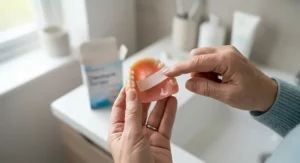
The 15-pack is the sensible starting point if you haven’t tried Seabond before. You’re spending a fraction less, and it gives you a fortnight to assess whether the format suits your jaw shape and lifestyle before committing to the larger 30-pack.
The formula is identical to the 30-pack — same kelp-derived adhesive, same zinc-free fabric construction, same lower-specific shaping. The practical difference is simply that you’re trialling rather than committing. UK dentists often suggest this approach: try a small pack first, because what works brilliantly for your neighbour may be entirely wrong for the anatomy of your lower ridge.
This is the pick for newly fitted lower denture wearers who are still finding their feet. The initial learning curve — moistening the seal correctly, trimming to fit, pressing out air bubbles — is real, and it’s far better to make those early adjustments with 15 seals than 30.
✅ Ideal trial size before buying larger packs
✅ Same quality formula as the 30-pack
✅ Prime-eligible on Amazon.co.uk
❌ Higher cost-per-seal than the 30-pack
❌ Not ideal for confident, established wearers who already know Seabond works for them
Price range: Under £7 — a low-risk starting investment.
3. Secure Denture Adhesive Waterproof Strips
Here’s the one that tends to come up in conversations about genuinely difficult lower dentures — the cases where standard seals just can’t get enough purchase. The Secure Denture Adhesive Strips have a non-water-soluble formula, which sets them apart from almost everything else in this category. Most adhesives are water-soluble: saliva gradually breaks the bond down throughout the day. Secure’s formula resists this degradation, which is why it holds longer for people with excess saliva or very flat lower ridges.
Each strip is a foam-based adhesive cushion that also acts as a soft liner, sitting between your gum and denture to relieve pressure and reduce the risk of sore spots. For anyone who’s experienced compression ulcers from an ill-fitting lower plate — a miserable, common experience — this dual function is rather more valuable than it sounds on paper.
UK buyers with flat or narrow lower gums consistently report this as their go-to. It’s available on Amazon.co.uk and typically qualifies for Prime delivery. One caveat: some users note that vigorous chewing of tough foods (think well-done beef, crusty bread) can cause the strip to shift slightly — so it’s not infallible, but it’s closer than most.
✅ Non-water-soluble — resists saliva breakdown
✅ Acts as soft liner, reducing gum irritation
✅ Specifically effective for flat/narrow lower ridges
❌ Can shift with very tough foods
❌ Slightly more expensive than Seabond per use
Price range: Under £12 per pack. Worth every penny if standard seals have failed you.
4. Super Poligrip Comfort Seal Strips
Poligrip is one of the most recognised names in denture care globally, and the Comfort Seal Strips are their strip-format answer to the mess of traditional cream. They’re zinc-free, individually wrapped (a nice touch for carrying a spare in your bag), and pre-cut — no trimming required, which immediately makes them more accessible for anyone with limited dexterity.
These are available on Amazon.co.uk (ASIN B0012DVJHM) and typically qualify for Prime. They claim around a 12-hour hold, which most users find broadly accurate for light-to-moderate eating. Where they perform less impressively is with hot drinks — something of a liability given that the average British morning involves at least two cups of tea — as the heat can soften the adhesive and reduce hold.
In practice, these are most useful as a secondary or travel option. They’re individually wrapped, which means they slip easily into a pocket or handbag, and for social occasions where you don’t need the full-day heavy-duty option, they’re a dependable choice. If you’re the sort who has a primary go-to adhesive at home but wants a portable backup for a trip to Newcastle or a long lunch, Poligrip Comfort Seal Strips are your answer.
✅ Pre-cut — no trimming needed
✅ Individually wrapped — perfect for travel
✅ Well-known, trusted brand
❌ Hold can weaken with hot drinks
❌ Less effective on very flat lower ridges than foam-based alternatives
Price range: Under £15. Sensible pick, especially if buying as a backup.
5. Cushion Grip Thermoplastic Denture Adhesive
Cushion Grip occupies a different category to the strips above — it’s a thermoplastic adhesive that softens in warm water, moulds to the exact contours of your lower gum, and then sets to provide a personalised cushioned fit lasting up to four days. In effect, it’s a temporary soft reline for your denture.
Available on Amazon.co.uk and frequently Prime-eligible, it’s particularly valuable for lower dentures that have become loose due to bone resorption — the progressive shrinkage of the jaw ridge that NHS Inform Scotland notes affects virtually all denture wearers over time. If your lower plate once fitted well but has gradually become loose, Cushion Grip can buy you months of comfortable wear while you await a professional reline appointment.
The learning curve is steeper than with standard strips. Getting the application right — warming the material to the correct consistency, seating the denture quickly and evenly — takes a couple of attempts. But once mastered, the four-day hold means considerably less daily fussing, which many wearers find liberating.
✅ Up to four-day hold — reduced daily effort
✅ Moulds to individual gum shape
✅ Excellent for loose dentures awaiting professional reline
❌ Learning curve on application
❌ Removal can be time-consuming
Price range: Under £15. Cost-per-day works out very competitively over a week.
6. Denttach Seven Denture Adhesive
If four days sounds appealing, seven sounds extraordinary — and Denttach Seven genuinely delivers it. This thermoplastic formula bonds through suction rather than traditional glue chemistry, and one application can last an entire week through normal eating, drinking, and overnight soaking.
It’s zinc-free and available on Amazon.co.uk, typically in the mid-price bracket. The target audience is the wearer who finds daily adhesive application genuinely taxing — whether due to limited hand mobility, a particularly hectic lifestyle, or simply fatigue with the morning routine. One application on a Monday morning and you’re largely set until the following weekend. That’s a meaningful quality-of-life difference.
The trade-off is that removal and reapplication after the seven-day period requires a bit of patience. And like Cushion Grip, initial application is an art form — moisten too little and it won’t bond properly; too much and the fit becomes sloppy. With practice, though, most users get it right by the second or third attempt. UK reviewers on Amazon.co.uk note it particularly suits lower dentures that fit reasonably but rock slightly.
✅ Up to seven-day hold — truly minimal daily maintenance
✅ Zinc-free, non-glue suction formula
✅ Well suited for those with limited manual dexterity
❌ Application takes practice
❌ Not ideal for dentures with severe fit issues
Price range: Under £15. Per-day cost is among the lowest of any option here.
7. Comfort Seal Pro Denture Adhesive
Rounding out the list is the Comfort Seal Pro, a thermoplastic gel formula that offers a daily-application option at an accessible price point. It’s available on Amazon.co.uk and sits at the budget end of the thermoplastic category — which doesn’t mean it underperforms, but it does mean you’re working with a slightly thinner gel consistency than the heavier-bodied Cushion Grip.
For a lower denture that fits reasonably well and just needs a bit of daily reassurance, Comfort Seal Pro does the job neatly. The gel applies cleanly, sets quickly, and most users find the removal process less involved than with longer-duration thermoplastics. It’s an especially sensible choice for wearers transitioning away from cream adhesives who want something more substantial than a fabric seal but aren’t ready to commit to the multi-day thermoplastic approach.
UK buyers on fixed incomes or simply looking for a no-fuss solution that doesn’t break the bank will find this a reliable workhorse.
✅ Budget-friendly daily option
✅ Cleaner application than heavy thermoplastics
✅ Good bridge between fabric seals and full thermoplastic systems
❌ Shorter effective hold than Cushion Grip or Denttach
❌ Less precision for severely ill-fitting plates
Price range: Under £10. The strongest value-for-money proposition in this list.
How to Choose Denture Strips for Lower Dentures in the UK — A Practical Framework
Choosing the right product involves more than reading a review — it requires matching the product type to your specific anatomical situation. Here are the criteria that actually matter:
1. Assess your ridge height. A relatively tall lower ridge can use most adhesive types. A flat or nearly flat ridge — very common in long-term denture wearers — demands a product like the Secure Strips with their non-water-soluble formula, which grips where conventional adhesives fail.
2. Consider your saliva levels. Excess saliva washes away water-soluble adhesives faster. If your lower denture tends to lose hold midday, a non-water-soluble strip (Secure) or a thermoplastic option will serve you better than fabric seals.
3. Think about your dexterity. Seabond seals require trimming and precise application. If your hands aren’t reliable in the morning, pre-cut Poligrip strips or a multi-day thermoplastic (apply once, done for the week) may be far more practical.
4. Factor in your lifestyle. Hot drinks, vigorous chewing, long days out — these all test adhesive hold. If you’re a three-brews-before-noon type or you’re partial to a chewy baguette at lunch, the multi-day thermoplastic options hold up considerably better under thermal and mechanical stress.
5. Check for zinc-free formulation. Every product on this list is zinc-free, which is worth verifying regardless of what you buy. Prolonged use of zinc-containing adhesives has been linked to neurological complications — a point worth emphasising given that some older products still in circulation are not zinc-free. For more information on safe denture use, the NHS denture care guide is a reliable starting reference.
6. Start with a smaller pack. Denture care is personal. What holds brilliantly for one lower jaw may barely grip for another. Buy a trial pack first.
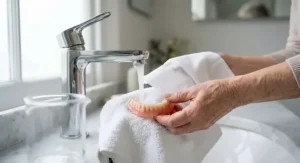
The Step-by-Step Guide: Applying Denture Strips for Lower Dentures Correctly
Getting the most from denture strips for lower dentures comes down to technique. Here’s the process that consistently delivers the best results:
Step 1 — Clean and dry your lower denture thoroughly. Any moisture or old adhesive residue left on the surface will dramatically reduce the new seal’s effectiveness. Pat the fitting surface dry with a clean cloth.
Step 2 — Trim to fit (for seals requiring it, like Seabond). Use clean scissors and a previously trimmed piece as a template. Cut all remaining seals to the same shape before you start — don’t fuss with scissors each morning.
Step 3 — Moisten the seal with warm water (not hot). Position it on the fitting surface of your lower denture, not too close to the edges. Press firmly. Smooth any air bubbles with a dry fingertip.
Step 4 — Insert the denture and bite down firmly for five to ten seconds. Hold steady. Don’t eat or drink for 10–15 minutes after insertion if possible — allowing the adhesive to set fully makes an appreciable difference to how long the hold lasts.
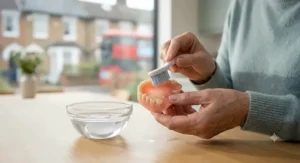
Step 5 — Remove carefully at the end of the day. For fabric seals, lift a corner and peel away. For thermoplastic types, soak the denture in warm water first to soften the material, then remove with a soft brush. Never force it — gum tissue is easily irritated.
UK-specific tip: British kitchens and bathrooms are often on the cooler side, particularly in older properties in winter. If your bathroom is chilly, warm water for moistening the seal is even more important — cold water won’t adequately activate kelp-derived adhesives.
Why Lower Dentures Are Harder to Keep in Place — The Science Behind the Problem
This deserves a proper explanation, because understanding the problem helps you choose the right solution.
As research on denture retention notes, when natural teeth are removed, the jawbone gradually loses density over time — it no longer receives the stimulation it needs from biting and chewing forces. The lower jaw resorbs faster than the upper, meaning the ridge your lower denture rests on shrinks progressively. A denture that fitted perfectly when new may feel noticeably loose within a few years simply because the shape of your jaw has changed beneath it.
Compound this with the anatomical disadvantage: the upper denture benefits from the broad suction of the palate. The lower sits on a narrow horseshoe-shaped ridge, constantly buffeted by tongue, cheek, and lip movement. According to dental professionals in the UK, even a technically well-fitted lower denture may shift during speech and eating — particularly if teeth were extracted long ago and the ridge has resorbed substantially.
Adhesive strips can’t undo bone loss. But the right product, applied correctly, can compensate for it substantially — turning an unruly plate into a reasonably reliable one. If you find yourself using ever-larger amounts of adhesive to maintain the same hold, that’s a signal to see your dentist about a reline, not a reason to buy a more powerful adhesive.
Denture Strips vs Cream: The Honest Verdict for Lower Dentures
This is the comparison most buyers are wrestling with, so let’s address it directly.
| Factor | Strips/Seals | Cream |
|---|---|---|
| Application | Clean, pre-measured | Can be fiddly, messy |
| Hold strength | Good to very good | Very good to excellent |
| Food seal | Good | Better |
| Taste | Neutral | Variable (some have strong mint) |
| Removal | Easy peel | Can leave residue |
| Cost per use | Slightly higher | Lower |
| Best for | Lower dentures, travel, arthritis | Strong hold priorities |
Cream adhesives generally achieve a marginally stronger hold — particularly for very loose lower plates — because they can fill irregular gaps in ways a flat strip cannot. However, the overwhelming advantage of strips and seals for lower dentures is practicality. No squeezing, no worrying about excess ooze, no flavour competing with your breakfast. For a lower denture that fits reasonably well and just needs daily support, strips and pads are the cleaner, more manageable choice.
The exception is a severely ill-fitting lower denture. In that scenario, a thermoplastic adhesive (or, ultimately, a professional reline) is required — no strip on the market will adequately compensate for a plate that has fundamentally lost its fit.
✨ Don’t Miss These Exclusive Deals!
🔍 Still deciding? Click any highlighted product above to check the latest price and availability on Amazon.co.uk. Prime members get next-day delivery on most of these picks — very handy when you’ve run out unexpectedly.
Common Mistakes When Buying Denture Strips for Lower Dentures
A few errors come up again and again — and they’re all avoidable:
Using upper seals for a lower denture. Seabond, for example, sells both upper and lower variants. They’re cut to different shapes. Using an upper seal in a lower denture means you’ll be trimming significantly and struggling with poor contour fit. Always confirm the pack says “Lowers.”
Applying to a damp denture surface. This is the single most common reason adhesive strips fail within an hour. The fitting surface must be dry before application. Any saliva or moisture present creates a layer between the adhesive and the acrylic, dramatically reducing grip.
Buying US-format products without checking UK availability. Some denture strip products popular in American online forums are not straightforwardly available on Amazon.co.uk. If you’re ordering from a third-party seller, verify delivery time and returns policy under the Consumer Rights Act 2015 — you have a 14-day cooling-off period for online purchases.
Overlooking the zinc question. While every product in this guide is zinc-free, some cheaper adhesives sold through third-party UK marketplaces are not. Always check the ingredients or packaging information before purchasing.
Treating adhesive strips as a long-term substitute for a professional reline. If you’re going through strips at an increasing rate to maintain the same hold, visit your dentist. A professional reline or new denture — available through NHS dentistry at Band 3 treatment charges — will make a far greater difference than any adhesive product.

FAQ: Denture Strips for Lower Dentures
❓ Are denture adhesive strips safe to use every day?
❓ Do denture strips work better than cream for lower dentures?
❓ Can I buy denture strips on Amazon.co.uk with Prime delivery?
❓ How do I remove denture adhesive strips from my lower denture at night?
❓ My lower denture still slips even with adhesive strips — what should I do?
Conclusion: The Right Strip Makes an Enormous Difference
The lower denture has always been the awkward younger sibling of denture care — less glamorous than implants, less discussed than the upper plate, but central to comfortable daily life for millions of people across the UK. Getting the adhesive right genuinely transforms the experience.
For most British wearers, Seabond 30 Lowers remains the benchmark: affordable, British-made, zinc-free, and shaped for the job. Those with flat or narrow ridges should look seriously at the Secure Denture Adhesive Strips — the non-water-soluble formula is a genuine practical advantage. If daily application is a burden, the thermoplastic options offer multi-day freedom that’s hard to argue against once you’ve mastered the application.
And remember: the best adhesive in the world won’t compensate for a denture that genuinely needs professional attention. If hold has deteriorated significantly, a conversation with your dentist is always the right first step.
✨ Don’t Miss These Exclusive Deals!
🔍 Ready to find your perfect fit? Click any highlighted product to check current pricing and real-time availability on Amazon.co.uk. Your lower denture deserves better — and so do you.
Recommended for You
- Denture Adhesive Powder vs Cream: 7 Best UK Picks (2026)
- Best Denture Adhesive Powder UK 2026: 7 Top Picks Reviewed
- Fixodent vs Poligrip Cream: 7 Best Denture Adhesives UK (2026)
Disclaimer: This article contains affiliate links. As an Amazon Associate, I earn from qualifying purchases. If you purchase products through these links, we may earn a small commission at no additional cost to you.
✨ Found this helpful? Share it with your mates! 💬🤗
