
In This Article
There you are, mid-conversation at a Sunday roast, biting into a particularly ambitious piece of crackling, and suddenly — something shifts. That subtle, deeply unsettling wobble. Your dentures have decided to make their presence felt at the worst possible moment. Sound familiar?
Knowing how to keep dentures in place is one of those things nobody warns you about before you get them fitted. The dentist hands you a gleaming new set of teeth, says “off you go,” and leaves you to discover — usually at a family gathering or in the middle of a sentence — that getting dentures to stay put is an art form in itself. A maddening, cracker-crumb-filled art form.
The good news? It’s entirely solvable. Understanding how to keep dentures in place comes down to three things: the right adhesive product, the right application technique, and knowing when the fit itself needs professional attention. Loose dentures aren’t always a product problem — sometimes they’re a biology problem, and recognising the difference will save you a small fortune on tubes of fixative cream.
According to NHS guidance from Guy’s and St Thomas’ NHS Foundation Trust, some degree of loosening over time is perfectly normal due to bone resorption — the natural shrinkage of the jawbone that occurs once teeth are removed. It’s expected. It’s manageable. And with the right products and techniques, it needn’t interrupt your crackling consumption at all.
This guide covers the seven best denture adhesives available on Amazon.co.uk right now, plus everything you need to know about application, fit, and when to call the dentist. Let’s get into it.
Quick Comparison: Best Denture Adhesives at a Glance
| Product | Format | Hold Duration | Zinc-Free | Best For |
|---|---|---|---|---|
| Poligrip Ultra Fixative Cream | Cream | Up to 12 hrs | ✅ | Everyday all-day use |
| Poligrip Flavour Free Cream | Cream | Up to 12 hrs | ✅ | Sensitive palates |
| Fixodent Complete Cream | Cream | All day | ✅ | First-time denture wearers |
| Fixodent Dual Power Cream | Cream | All day+ | ✅ | Very loose/older dentures |
| Seabond Fixative Seals | Cushion pads | All day | ✅ | Mess-haters, partial wearers |
| Cushion Grip Thermoplastic | Thermoplastic | Up to 4 days | ✅ | Long-term comfort wearers |
| Poligrip Power Max | Cream | All day | ✅ | Maximum hold + food seal |
The table above tells a clear story: creams dominate the everyday market for good reason — they’re reliable, widely available, and relatively straightforward to use. But they’re not universally perfect. If you’re exhausted by the morning tube-squeezing routine, Seabond’s pad format or Cushion Grip’s multi-day thermoplastic formula could genuinely change your quality of life. Meanwhile, Fixodent Dual Power is the one to reach for when your dentures are older and the fit has drifted noticeably — it compensates for looseness in a way that lighter creams simply can’t.
💬 Just one click — help others make better buying decisions too! 😊
✨ Don’t Miss These Exclusive Deals!
🔍 Take your denture comfort to the next level with these carefully selected products. Click on any highlighted item below to check current pricing and availability on Amazon.co.uk. These picks will help you find exactly what you need!
Top 7 Denture Adhesives for UK Wearers: Expert Analysis
1. Poligrip Ultra Fixative Cream (40g / 70g)
The bestseller. Over 8,000 reviews on Amazon.co.uk and consistently one of the top-purchased products in the denture adhesive category — that doesn’t happen by accident. Poligrip Ultra uses two adhesive polymers that absorb moisture from your saliva and expand, interlocking to form a flexible cushion between your denture and gum tissue. The practical upshot is a hold that moves with you rather than cracking under pressure — rather important when you’re tucking into something with a bit of resistance.
The fresh mint flavour is the version to grab if taste matters to you; it freshens breath gently without being overwhelming. UK buyers should note that the 70g tube is much better value per gram — worth considering if you’re on a budget and use adhesive daily. Prime-eligible for next-day delivery across most UK postcodes.
UK customer reviews are broadly positive, with most noting it holds comfortably through a full working day and handles normal meals well. A handful mention it struggles slightly with very crusty bread or sticky toffee — but then, most things struggle with sticky toffee.
✅ Holds firmly through meals and conversation
✅ Fresh mint variant masks denture odour gently
✅ Zinc-free formula — safe for daily use
❌ Oozes if you use too much (takes a session or two to find your ideal amount)
❌ Removing residue at night requires a little effort
Available in the low-to-mid single-figure price range for a 40g tube; multi-packs reduce cost considerably. A sensible first choice for most wearers.
2. Poligrip Flavour Free Fixative Cream (40g / 70g)
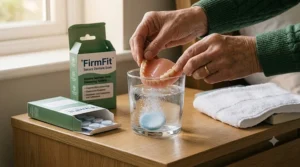
Identical formula to the Ultra, stripped of the mint. Sounds like a minor variation — but for a meaningful chunk of denture wearers, it’s the only option that makes sense. If you enjoy tea with your breakfast and don’t want a lingering mint note interfering with it, this is your product. Equally useful for anyone who has a sensitivity to menthol or simply prefers their morning cup of Earl Grey to taste of Earl Grey, not spearmint.
The flavour-free version is also fractionally easier to judge in terms of quantity — without the mint sensation amplifying the feeling of “something in your mouth,” first-time users often find it easier to calibrate how much they need. Two or three small strips along the denture ridge, not a continuous bead — that’s the technique that prevents oozing.
UK reviewers praise its reliable all-day hold and the absence of any taste interference with food. The 6-pack of 70g tubes represents excellent value and is worth buying if this becomes your regular product — you’ll save noticeably over buying single tubes.
✅ No taste interference — ideal for food and drink enthusiasts
✅ Same proven polymer formula as the Ultra
✅ Available in large-format tubes for better value
❌ No breath-freshening benefit (matters to some)
❌ Takes a few applications to find your ideal strip length
Around the same price range as the Ultra. If you find the mint distracting, this is the easy swap.
3. Fixodent Complete Denture Adhesive Cream (40g / multipack)
Fixodent Complete holds the rather distinguished honour of being the only denture fixative cream approved by the British Dental Health Foundation — a stamp of credibility that carries weight in the UK market. The formula works differently to Poligrip: the natural moisture in your mouth activates the cream, causing it to transform into an elastic-like membrane that grips the denture snugly. The result is what Fixodent describes as a three-pronged benefit: hold, comfort (via cushioning), and food seal.
In practice, that food seal is genuinely useful. Anyone who has had a piece of sweetcorn find its way under a lower denture will understand precisely why this matters. The Complete version provides a reliable all-day hold for most wearers, and the mint flavour is pleasant without being aggressive.
Ideal for newer denture wearers getting to grips with the routine, and for anyone who values a trusted British-approved product. Available in multipacks (4×40g) at notably reduced cost per tube — sensible purchasing if denture adhesive is now a regular household item.
✅ Approved by the British Dental Health Foundation
✅ Food seal reduces irritating debris under dentures
✅ Widely available — often in stock on Amazon and at Boots and Superdrug
❌ Hold may be slightly less aggressive than Dual Power for very loose denture
❌ Contains zinc — check if this is a concern for you
Widely considered fair value; the multipack option is particularly good.
4. Fixodent Dual Power Denture Adhesive Cream (35ml)
Think of Dual Power as Fixodent’s “when things have gotten serious” option. It activates quickly — faster than the standard Complete — creating a strong initial bond, and then gradually releases adhesive throughout the day to maintain hold over a longer period. In plain English: it grabs fast and holds stubbornly.
This is the product to reach for if your dentures are a few years old and have drifted in fit due to bone resorption — which, as outlined by South Kensington Medical & Dental’s research-backed explainer, is an almost inevitable process for all denture wearers over time. When the ridge has flattened and your standard cream isn’t quite cutting it through a full day, Dual Power fills the gap — literally and figuratively.
UK customer feedback is excellent, with multiple reviewers stating it outperforms competitor brands and holds through an entire day with minimal re-application. One reviewer noted they’d switched from the standard Complete after their dentures became looser with age and described the difference as “night and day.”
✅ Stronger hold than standard creams — ideal for older or slightly loose dentures
✅ Quick activation for instant confidence on fitting
✅ Cushioning element relieves gum discomfort
❌ Slightly stronger hold can make removal at night more involved
❌ Not necessary if your dentures still fit well — save the heavy artillery
Mid-range single-figure price for 35ml. Worth every penny if your dentures are misbehaving.
5. Seabond Denture Fixative Seals (30 Uppers / 30 Lowers)
The category rebel. While everyone else competes on the cream and powder axis, Seabond does something genuinely different — pre-formed adhesive pads that you trim to size, moisten, and press onto the denture. No tubes, no squeezing, no guessing how much is too much. You apply once, and that’s your day sorted.
The appeal is real, particularly for anyone who finds cream-based adhesives messy or fiddly. No oozing at the edges; no cream residue to scrub off gums at night. The pads lift off cleanly and are discarded daily. They’re also approved by the Oral Health Foundation, and the zinc-free formula makes them suitable for long-term daily use.
The critical caveat: upper and lower versions are sold separately, so check which you need before ordering. The technique takes a little getting used to — trimming the pad correctly makes a significant difference to hold quality. Reviews on Amazon.co.uk are somewhat polarised: devotees absolutely swear by them (“wouldn’t use anything else”), while others find the trimming and moistening routine more effort than a tube. Honestly, worth trying if you find creams messy.
✅ Pre-formed pads — no oozing, no mess
✅ Oral Health Foundation approved
✅ Clean removal — lifts off rather than scrubbing off
❌ Sold as uppers or lowers — easy to buy the wrong type
❌ Trimming to fit takes practice; poor trimming reduces hold quality
Mid-range price per pack for 30 seals. Good value given you use one per day.
6. Cushion Grip Thermoplastic Denture Adhesive (1oz / approx. 28g)
This one’s in a category of its own — and for certain wearers, it’s an absolute revelation. Cushion Grip isn’t a traditional adhesive. It’s a thermoplastic material: you warm it in hot water, apply it to the denture, and it moulds to the exact shape of your gum tissue, creating a custom-fit cushion that holds for up to four days per application. Four days. Not four hours.
The practical implications are significant. You’re applying every few days rather than every morning. The hold is described as waterproof — it doesn’t break down in saliva the way cream adhesives do — and it doubles as a soft reliner, actually filling minor gaps between the denture and gum that have developed through bone resorption. For anyone who finds the daily adhesive routine genuinely tedious, this is an intriguing alternative.
The learning curve is real, however. First-time application takes some patience — the instructions advise warming the tube in hot water before use, which catches people out if they skip that step. Some users on Amazon.co.uk report it didn’t suit their specific denture geometry; others describe it as the product they’d been searching for for years. It’s zinc-free, which is a meaningful plus for daily users.
✅ Up to 4-day hold — dramatically reduces daily faff
✅ Acts as a soft reliner — compensates for bone loss-related looseness
✅ Waterproof — won’t dissolve mid-meal
❌ Requires heat activation — steeper learning curve than a tube of cream
❌ Not suitable for all denture shapes; lower dentures can be trickier
In the higher single-figure price range for 1oz. Considering one tube lasts significantly longer than a standard cream, the cost-per-day is quite competitive.
7. Poligrip Power Max Power Hold Plus Seal (62.5g)
Poligrip’s premium offering and, gram-for-gram, arguably the most comprehensive cream adhesive on this list. The larger 62.5g tube is designed for wearers who want serious hold and a proper food seal in a single product — the “Power Max” designation isn’t entirely marketing fluff. UK buyers will appreciate the taste-free formula (the name suggests intensity; the taste profile is mercifully neutral), and the ooze-control tip makes precise application noticeably easier than older-style tubes.
For those who’ve tried standard Poligrip Ultra and found it slightly lacking on particularly challenging days — a full Sunday lunch, an evening out, anything requiring confident, uninhibited biting — Power Max is worth the step up. It costs more per gram but you may find yourself using slightly less per application due to the stronger hold.
UK customer reviews are strong, with most noting it outperforms the standard Ultra for demanding use cases. Excellent for anyone who eats out frequently, socialises over meals, or simply wants maximum confidence without thinking about their dentures.
✅ Strongest hold in the Poligrip cream range
✅ Built-in food seal — keeps debris out during meals
✅ Taste-free, large format tube with ooze-control tip
❌ Costs more than standard Poligrip per tube
❌ The extra hold makes complete daily removal slightly more work
Mid-to-upper single-figure price range; represents good value given the larger tube size.
Why Your Dentures Keep Coming Loose: The Real Reason Nobody Tells You
Here’s the thing about loose dentures that most adhesive marketing quietly glosses over: the product isn’t always the problem. Sometimes — often, eventually — the problem is your jawbone.
When natural teeth are extracted, the jawbone loses the stimulation it relied on to maintain its density and shape. The result is a gradual, entirely natural process called bone resorption — the jaw ridge literally shrinks over time. Research confirms that some patients lose 2–4 millimetres of bone width in the first six months after extraction alone, with slower but continuous loss continuing throughout life. The denture fitted perfectly three years ago may simply no longer match the jaw it sits on.
This explains several things you may have noticed:
Lower dentures loosen faster than upper dentures. The lower jaw typically resorbs more quickly, which is why lower denture adhesion is a more common complaint. The NHS acknowledges this directly — and it’s why dentists recommend returning for denture relines every few years, even if the dentures themselves are structurally intact.
Using more and more adhesive over time is a warning sign, not a solution. If you’ve noticed your adhesive use creeping up — more product, more applications per day — your dentures may be telling you they need professional attention: a reline, a rebase, or potentially a new set. NHS Band 2 dental treatment (which covers denture work) currently costs a set charge in England; check NHS.uk for current charges in your region as these are updated periodically.
Weight loss accelerates loosening. Significant changes in body weight alter the soft tissue profile in your mouth, meaning a denture that fitted at one weight may not fit at another. This is more common than most people expect.
The upshot: adhesives are a legitimate and effective solution for everyday stability. But they’re a management tool, not a substitute for dental care.
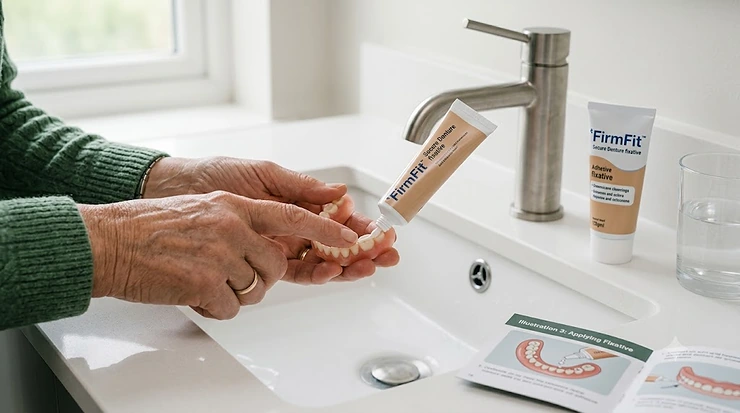
Denture Adhesive Application: The Technique That Actually Works
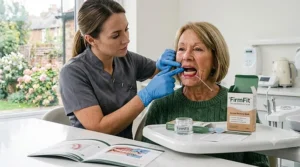
Most denture wearers apply too much adhesive. Far too much. The instinct is understandable — more grip, more security — but it’s precisely backwards. Excess adhesive oozes around the edges, tastes strange, and can actually interfere with the natural suction that’s a key part of denture retention. Less is genuinely more.
Here’s the approach that works for cream adhesives:
Step 1: Start dry. Cream adhesives perform best on clean, dry dentures. Pat them dry with a tissue after cleaning — don’t apply over a wet denture.
Step 2: Three small strips, not a bead. For an upper denture, apply three short strips from front to back: one along each side, one central (leaving the very edges clear). For a lower denture, three smaller dots along the centre ridge. The cream expands with moisture — those small deposits become much larger than they look.
Step 3: Rinse and press. Rinse your mouth lightly with warm water, insert the denture, press firmly into place, and hold your bite down for around 10–15 seconds. That pressure is doing real work — don’t rush it.
Step 4: Wait before eating. Give the adhesive 5 minutes to activate before your first bite. Eating too quickly is a common reason adhesives underperform.
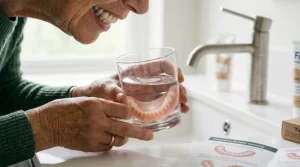
Step 5: Remove properly at night. Swish warm water around your mouth, gently rock the denture from side to side before lifting — never wrench it straight out. Clean the gum tissue and denture thoroughly before morning reapplication.
The most common mistake is re-applying mid-day because the hold has lessened. Before you do, drink some water and reseat the denture with firm pressure — often the bond just needs reactivating. If you genuinely need twice-daily application, it’s a signal the dentures need professional attention.
Real-World Scenarios: Which Adhesive Suits Which UK Wearer
Margaret, 72, retired teacher in Sheffield. She wears full upper and lower dentures and her main concern is her weekly lunch club at the village hall — three courses, lively conversation, and the occasional hard biscuit with her tea. She tried Seabond pads but found the trimming fiddly. The Fixodent Dual Power is her product: fast activation, all-day hold, and no re-application needed. The food seal element means she can tackle the lunch club’s more ambitious puddings without anxiety.
David, 65, semi-retired accountant in Bristol. He has a partial lower denture and a full upper. He wears both all day but his main irritant is morning coffee — he drinks a lot of it, and the mint flavour in most adhesives clashes badly with his first cup. Poligrip Flavour Free, 70g tube, bought in packs of three: zero taste interference, reliable hold, and excellent value per application.
Pauline, 68, grandmother in Edinburgh. Her dentures are five years old and noticeably looser than when she first had them made. She’s waiting for a dental appointment to discuss relining, but in the meantime she needs them to stay put at her granddaughter’s birthday party this Saturday. Cushion Grip thermoplastic is her interim solution: it effectively acts as a temporary soft reliner, filling the gap that bone resorption has created and providing four days of comfortable hold between her dental visits.
Common Denture Problems — And Honest Solutions
Problem: Lower denture lifts when you talk or chew. This is the classic bone resorption scenario — the lower jaw resorbs faster than the upper, leaving less ridge for the denture to grip. Short-term solution: Cushion Grip or Fixodent Dual Power. Medium-term: ask your dentist about a reline. Long-term: consider whether implant-retained dentures are an option.
Problem: Denture feels secure in the morning but loosens by afternoon. Almost always an application issue. You’re likely using too much adhesive (which oozes and breaks the seal) or applying to a slightly damp denture. Dry thoroughly, use less product, and press firmly for a full 15 seconds on insertion.
Problem: Cream adhesive oozes over gums and tastes unpleasant. Again, too much product. But also: consider switching format entirely. Seabond pads are specifically designed to prevent oozing — they’re worth trying if this is a persistent frustration.
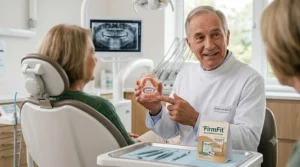
Problem: You’ve started needing adhesive when you didn’t before. Your dentures need professional attention. This is bone resorption doing its work. A reline from a dentist — which adds new material to the fitting surface to match the changed jaw shape — should restore a close fit. According to the Oral Health Foundation, dentures typically benefit from a professional review every two years and replacement around every five to ten years.
Problem: Gum soreness after adhesive use. Check the product for zinc content (older Fixodent formulas contained zinc; newer versions are zinc-free, as are all the products listed here). If soreness persists with a zinc-free product, stop use and see your dentist — poorly fitting dentures can cause chronic gum irritation that adhesive simply masks.
How to Choose the Right Denture Adhesive in the UK: A Buyer’s Framework
Choosing the right denture adhesive for your specific situation isn’t complicated, but a few key questions will narrow it down quickly:
- How well do your dentures currently fit? If they’re relatively new and well-fitted, a standard cream (Poligrip Ultra, Fixodent Complete) will be entirely sufficient. If they’re older and noticeably looser, step up to Fixodent Dual Power or Cushion Grip.
- Do you want daily application or longer intervals? Cream adhesives are daily products. If the daily routine feels burdensome, Cushion Grip’s 4-day hold may be transformative.
- Does taste matter to you? Mint-flavoured creams are the default, but Poligrip Flavour Free and Poligrip Power Max taste-free formula give you the same performance without the flavour profile.
- Do you prefer no mess? Seabond pads are the nearest thing to a mess-free option in this category — no oozing, no residue scrubbing, clean daily removal.
- Do you have a zinc sensitivity? All products listed here are zinc-free as formulated, but always check the current packaging as formulations can be updated.
- Do you have partial or full dentures? Most creams work for both. Seabond pads come in upper and lower versions and suit partials well if shaped correctly.
Long-Term Denture Care and Cost in the UK: What You Should Budget For
Denture adhesive is a modest ongoing cost — typically a few pounds a month for daily cream users, or similar for pad or thermoplastic alternatives. The more significant costs worth planning for are professional:
- NHS denture reline (England): Covered under Band 2 treatment. A reline adds new material to restore the fit when bone resorption has caused looseness — typically needed every 3–5 years.
- Private denture reline: £150–£400 depending on the practice and type of reline (chairside or laboratory).
- New full dentures (NHS, England): Covered under Band 3 treatment. Private costs vary enormously — £800–£3,000 for a complete set depending on material and practice.
- Implant-retained dentures: £1,500–£3,500 per implant privately. A long-term investment, but one that eliminates the bone resorption problem by stimulating the jaw and eliminates adhesive dependence entirely. Worth discussing with your dentist if loose dentures are a persistent quality-of-life issue.
The running cost of adhesive cream is genuinely low — a multipack of Fixodent 4×40g works out at pence per day. The real cost of inadequately managed loose dentures is harder to quantify: the meals avoided, the conversations held back, the Sunday roasts eaten with unnecessary anxiety.
Frequently Asked Questions About Keeping Dentures in Place
❓ Does the NHS cover denture adhesives in the UK?
❓ Are denture adhesives with zinc safe to use every day?
❓ How often should I have my dentures checked by a dentist?
❓ Can I sleep with my dentures in while using adhesive?
❓ My lower denture keeps lifting when I speak — is that normal?
Conclusion: Confidence Is Just a Well-Applied Strip of Adhesive Away
Loose dentures are one of those problems that sounds minor from the outside and feels enormous from the inside. The constant monitoring, the self-consciousness at mealtimes, the slight holding-back in conversations — it’s genuinely wearing. The good news, as this guide hopefully demonstrates, is that the solution is usually straightforward.
For most people, a high-quality adhesive — applied correctly, in the right quantity, to a clean dry denture — is all it takes to reclaim a full, unrestricted daily life. Whether that’s Poligrip Ultra for reliable everyday hold, Fixodent Dual Power for older dentures that have drifted in fit, or Cushion Grip for wearers who want to banish the daily routine altogether, there’s a product on this list for every situation.
The important caveat: if your adhesive use is escalating, or if discomfort persists, don’t keep throwing product at the problem. See your dentist. A reline or new dentures will do what no amount of adhesive can — restore an actual fit. And that’s worth prioritising.
✨ Ready to Find Your Perfect Denture Fix?
🔍 Click any highlighted product above to check current pricing and availability on Amazon.co.uk. Prime members get free next-day delivery — most of these products are in stock and ready to ship. Don’t let loose dentures keep you from living your life fully!
Recommended for You
- Best Denture Fixative UK 2026: 7 Top Picks That Actually Hold
- Best Antibacterial Denture Cleaner UK 2026: Top 7 That Kill Bacteria Fast
- Denture Brush vs Regular Toothbrush: 7 Best UK Picks 2026
Disclaimer: This article contains affiliate links. As an Amazon Associate, I earn from qualifying purchases. If you purchase products through these links, we may earn a small commission at no additional cost to you.
✨ Found this helpful? Share it with your mates! 💬🤗
