
In This Article
There’s a particular kind of panic that comes with a denture shifting mid-sentence at a dinner party. One second you’re mid-anecdote, the next you’re clamping your jaw shut and hoping nobody noticed the wobble. If that sounds familiar, you’re not alone, and you’re not doing anything wrong — gums and jawbones change shape over time, and even a beautifully made denture will eventually loosen. The right denture adhesive for loose dentures buys you comfort, confidence and chewing power while you sort out the longer-term fix with your dentist.
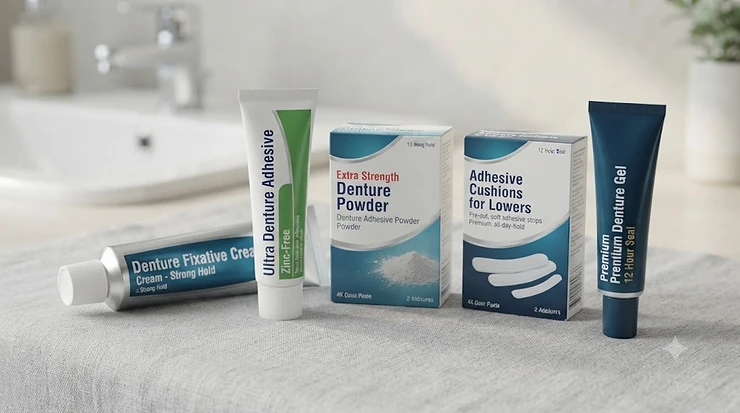
This guide isn’t a rehashed Amazon listing. It’s a proper look at seven real, currently available products — creams, powders, seals and thermoplastic reliners — with honest analysis of who each one suits, what the aggregated reviews say, and where the real value lies. We’ll also dig into why dentures become loose in the first place, unpack the science behind ridge resorption, and settle the denture relining vs adhesive debate once and for all. Denture adhesive for loose dentures isn’t a single miracle tube; it’s a category with real trade-offs, and understanding those trade-offs is what actually helps you chew a steak again without drama.
What is denture adhesive for loose dentures? In short, it’s a cream, powder, cushion or strip applied between your denture and gums that fills small gaps, increases suction and improves grip — a genuine short-term solution, not a substitute for a dentist checking your fit. Let’s get into the detail.
Quick Comparison Table
| Product | Type | Best For | Hold Time | Price Range |
|---|---|---|---|---|
| Fixodent Complete Original | Cream (zinc) | Budget all-rounders | Up to 12 hrs | Around £4-£6 |
| Poligrip Ultra Fixative Cream | Cream | Strong daily grip | Up to 12 hrs | £4-£7 range |
| Corega Extra Strong Cream | Cream (zinc-free) | Sensitive gums | Up to 12 hrs | £5-£8 range |
| Corega Ultra Adhesive Powder | Powder | Excess saliva | Up to 12 hrs | £5-£9 range |
| Sea-Bond Fixative Seals | Strips/seals | Mess-free travel | Up to 12 hrs | £6-£10 range |
| Poligrip Flavour Free Cream | Cream (zinc-free) | Taste-sensitive eaters | Up to 12 hrs | Mid-£5 to £9 |
| Cushion Grip Thermoplastic | Soft reliner | Loose or ill-fitting plates | Up to 4 days | £10-£15 range |
Looking at the spread above, the two zinc-free creams (Corega Extra Strong and Poligrip Flavour Free) sit at the mid-to-premium end but earn their keep for anyone worried about long-term zinc exposure. The Sea-Bond seals and Cushion Grip thermoplastic occupy a different niche entirely — less about daily grip, more about bridging a genuinely loose-fitting plate until a dentist can reline it. Budget shoppers gravitate towards Fixodent, but as we’ll cover in the safety section below, that convenience comes with a zinc caveat worth knowing about.
💬 Just one click — help others make better buying decisions too!😊
Top 7 Denture Adhesives for Loose Dentures: Expert Analysis
1. Fixodent Complete Original Denture Adhesive Cream — the household-name budget hold
Fixodent has been on bathroom shelves since 1968, and that longevity buys it a certain trust that newer brands haven’t earned yet. The cream delivers what the brand calls up to ten times stronger hold than wearing no adhesive at all, and the light mint flavour makes it one of the less unpleasant options to apply first thing in the morning.
Key specs worth noting: it’s a petrolatum-and-polymer cream applied to clean, dry dentures, and it contains zinc as a cross-linking ingredient that helps the adhesive stay put through a full day of talking and eating. In practice, that zinc is precisely what gives Fixodent its reputation for a genuinely tenacious hold on both uppers and lowers — but it’s also the reason dental bodies advise against daily long-term use without a break.
This is the adhesive for someone who wants a reliable, no-fuss option and isn’t planning to use it multiple times a day, every day, for years on end. Reviewers consistently report a strong initial grip and minimal taste interference once it sets, though a subset of users mention it can feel greasy if over-applied. Aggregated feedback across retailer reviews also flags that a little genuinely goes a long way — overuse is the most common complaint, not underperformance.
Pros:
✅ Trusted, decades-long track record with dentists
✅ Strong hold reported across thousands of reviews
✅ Mild mint flavour doesn’t overpower food taste
Cons:
❌ Contains zinc, unsuitable for constant daily long-term use
❌ Can feel greasy if applied too thickly
At around £4-£6 for a standard tube, this remains one of the cheapest ways to test whether adhesive helps your particular fit at all — solid value if you use it sparingly and switch to a zinc-free option for everyday wear.
2. Poligrip Ultra Fixative Cream — best all-day grip for busy eaters
Made by Haleon (formerly part of GSK), Poligrip Ultra uses a two-polymer system that absorbs saliva and expands, interlocking to form a cushioned, flexible seal between denture and gum. The fresh mint variant is designed for people who don’t want to think about their dentures again until bedtime.
What that expanding-polymer mechanism means in practice is a more forgiving hold than a simple glue-style adhesive — it flexes as you chew rather than cracking or shifting, which matters enormously if your jaw does a lot of lateral movement (think steak, crusty bread, or corn on the cob). Reviewers consistently note it copes well with harder foods that would defeat a thinner cream, and several long-term users mention switching from Fixodent to Poligrip specifically for the improved comfort during eating.
Based on the spec comparison with Fixodent, Poligrip Ultra sits a notch above on flexibility but isn’t zinc-free, so it carries the same long-term-use caveat. It’s best suited to people newly adjusting to dentures who want confidence at mealtimes without yet committing to a full relining appointment.
Pros:
✅ Flexible, expanding hold copes well with chewy foods
✅ Ooze-control tip reduces mess during application
✅ Widely available across UK pharmacies and supermarkets
Cons:
❌ Still zinc-containing, same long-term caution applies
❌ Some reviewers note a slight aftertaste before it fully sets
Expect to pay in the £4-£7 range for a standard 40g tube — solid mid-market value, particularly if eating with confidence matters more to you than avoiding zinc entirely.
3. Corega Extra Strong Denture Adhesive Cream — best zinc-free daily option
Corega, sold under the Polident/Haleon umbrella outside North America, has quietly become one of the most recommended zinc-free creams for people who wear adhesive every single day. The “Extra Strong” formulation targets denture wearers who’ve found standard-strength creams simply don’t last through a full working day.
The zinc-free formula matters here in a very concrete way: because it swaps zinc-based cross-linking for alternative polymers, it’s the adhesive dentists tend to suggest for people who apply cream daily rather than occasionally. That’s a meaningful practical distinction the spec sheet alone won’t spell out — it’s the difference between “fine for special occasions” and “fine for the rest of your life.” Aggregated review sentiment describes a firm, all-day hold with minimal reapplication needed, though a handful of users mention needing a slightly larger amount than expected to get a full seal on the first try.
This is the pick for anyone who’s realised adhesive isn’t a stop-gap for them but a permanent part of their morning routine, and who’d rather not think about cumulative zinc exposure over years of use.
Pros:
✅ Zinc-free, suitable for genuine everyday long-term use
✅ Strong hold reported through full working days
✅ Widely stocked across UK high street pharmacies
Cons:
❌ Some reviewers found dosing less intuitive than cream competitors
❌ Availability of specific variants can be inconsistent online
Price sits in the £5-£8 range depending on pack size — a fair premium over Fixodent, and one most daily users consider worth paying for the zinc-free peace of mind.
4. Corega Ultra Adhesive Powder — best for excess saliva
Powders are the unsung alternative to cream, and Corega’s Ultra Adhesive Powder is a genuinely well-regarded example — a fine, zinc-free powder sprinkled onto a wet denture rather than a dry one, where it interacts with saliva to form the seal.
Here’s what most buyers overlook about powder formats: because they’re applied to a wet surface rather than a dry one, they suit people who naturally produce more saliva far better than creams do, since excess moisture can actually thin out and weaken a cream’s bond, whereas it’s precisely what activates a powder. The practical dosing cap allows more control over quantity than most creams offer, and the manufacturer notes you can adjust the amount according to need — useful for finding your own sweet spot without wasting product.
Reviewers who switched from cream to powder often cite reduced “gunge” build-up along the denture edge and an easier clean-up at the end of the day. It’s a genuinely different feel to cream and takes a short adjustment period to master the technique of sprinkling evenly.
Pros:
✅ Zinc-free formula suitable for daily use
✅ Ideal for wearers with naturally excess saliva
✅ Less messy residue build-up than thick creams
Cons:
❌ Learning curve for even application first-time
❌ Not as strong a hold as premium creams for very active chewers
Expect a £5-£9 range for a standard pack — comparable to Corega’s cream, and worth the switch if you’ve found creams consistently thin out and fail by mid-afternoon.
5. Sea-Bond Denture Fixative Seals — best mess-free option for travel
Sea-Bond takes an entirely different approach: pre-cut, waterproof adhesive seals rather than a cream or powder. Around for roughly seven decades, they’re zinc-free and activate on contact with moisture, forming a cushioned pad between denture and gum.
The trimmable design is the standout feature here in practice — because the seals can be cut down with scissors, they work for partial dentures as well as full plates, something creams handle less elegantly since you can’t easily control where a cream spreads. Reviewers consistently describe the seals as genuinely mess-free compared with cream or powder, with no gunky clean-up required at the end of the day, and many specifically praise the “cushiony soft feel” against sore or sensitive gum tissue.
This is the pick for holidaymakers, people attending events where reapplication mid-day isn’t practical, or anyone whose gums are simply too tender for a traditional cream. The trade-off is thickness: if your denture already fits reasonably well, the seal’s extra bulk can occasionally feel intrusive rather than corrective.
Pros:
✅ Genuinely mess-free application and removal
✅ Trimmable to fit partial dentures precisely
✅ Cushioned feel is gentler on sore or sensitive gums
Cons:
❌ Added thickness can feel bulky if your fit is already close
❌ Pricier per-use than cream or powder over time
Pricing typically runs £6-£10 range for a pack of seals — a premium format, but one that earns its keep for anyone who’s tried and disliked traditional creams.
6. Poligrip Flavour Free Denture Fixative Cream — best for taste-sensitive eaters
The flavour-free variant of Poligrip strips out the mint and artificial colourants entirely, aiming squarely at people who’ve found flavoured adhesives interfere with the taste of food — a bigger deal than it might sound, since taste is already one of the first things people say they miss after losing natural teeth.
Functionally it uses the same two-polymer expanding system as Poligrip Ultra, holding up to roughly twelve hours according to the manufacturer, but the zinc-free, colourant-free formula means it’s positioned for genuine everyday use rather than occasional top-up. What the ingredient list won’t tell you outright, but user reports suggest, is that the ooze-control nozzle on this variant is noticeably tidier than older Poligrip packaging — a small but real quality-of-life improvement if you’ve been frustrated by messy application in the past.
This is the adhesive for people who’ve tried mint or flavoured creams and found them off-putting, or who simply want their morning coffee to taste like coffee rather than toothpaste.
Pros:
✅ Zinc-free and colourant-free for everyday use
✅ No flavour interference with food or drink
✅ Improved ooze-control application tip
Cons:
❌ Marginally pricier than the standard flavoured variant
❌ Some reviewers still detect a faint chemical taste initially
Expect to pay in the mid-£5 to £9 bracket depending on tube size — worth the small premium if flavour interference has been putting you off adhesive altogether.
7. Cushion Grip Thermoplastic Denture Adhesive — best for genuinely loose or ill-fitting plates
Cushion Grip works completely differently from everything above it on this list: it’s a thermoplastic soft reliner, not a traditional adhesive. Warmed slightly by the temperature of your mouth, it moulds itself to the exact contours of your gums, acting more like a temporary reline than a simple grip-booster.
That distinction matters enormously in practice. Where a cream or powder fills small gaps and adds friction, Cushion Grip actually reshapes to fit a denture that’s become genuinely loose — which is why several NHS-adjacent forum discussions and denture-wearer communities describe it as a game-changer for interim or temporary dentures still settling after extraction, or older dentures that have outpaced a simple adhesive’s ability to cope. It claims to hold for up to four days per application, a dramatically longer window than any cream on this list.
This is squarely the pick for anyone whose denture isn’t just “a bit loose” but noticeably ill-fitting, and who needs a genuine stopgap while waiting for a professional reline or a replacement set. It is not, and shouldn’t be treated as, a permanent substitute for seeing a dentist.
Pros:
✅ Reshapes to gum contours rather than just adding grip
✅ Up to four-day hold per application
✅ Non-glue, zinc-free, waterproof formula
Cons:
❌ Considerably pricier than cream or powder adhesives
❌ Not a substitute for a proper dentist-fitted reline
Pricing sits highest on this list at around £10-£15 range, but for a genuinely loose plate, it’s often cheaper and more comfortable than repeated cream reapplications throughout the day.
Practical Usage Guide: Getting the Most From Your Adhesive
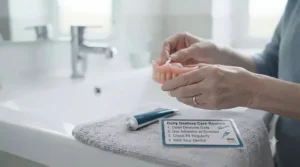
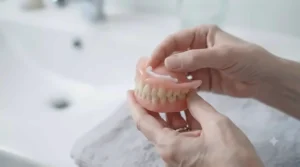
Applying denture adhesive well is a skill, and most people never get proper guidance on it beyond the instructions printed on the box. Start with clean, completely dry dentures for creams and powders — moisture stops cream from bonding properly, while powders need the opposite: a lightly wet surface to activate. Apply in short, broken strips or a light dusting rather than one continuous line; a common first-30-days mistake is over-application, which causes oozing, an uneven bite, and a genuinely worse fit than using nothing at all.
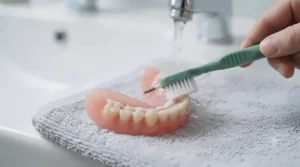
Press the denture firmly into place and hold for several seconds, biting down gently to set the seal, then rinse away any excess that squeezes out at the edges. Reapplication should happen once daily for most creams — if you’re finding yourself topping up multiple times before lunch, that’s a signal worth mentioning to your dentist rather than simply reaching for a stronger formula. Removal matters too: soften the seal with warm water before gently working the denture free, then clean off residue from both denture and gums with a soft brush, since leftover adhesive is a common cause of gum irritation and denture stomatitis over time — a point echoed in the Oral Health Foundation’s denture care guidelines, which stress consistent, correct daily cleaning as central to denture health.

Real-World Scenarios: Which Adhesive Suits Which Situation
Consider three different denture wearers. First, someone six weeks post-extraction wearing an immediate denture that’s still settling as gum swelling subsides — a genuinely loose fit that changes week to week. For them, a thermoplastic reliner like Cushion Grip makes more sense than cream, since it actively compensates for the shifting gap while they wait for their dentist to arrange a proper soft reline.
Second, a long-term denture wearer in their seventies with a well-fitting plate who simply wants extra confidence at family gatherings and restaurant meals. A zinc-free cream like Corega Extra Strong or Poligrip Flavour Free fits this profile well — daily use without the long-term zinc concern, applied to a denture that’s fundamentally sound rather than problematic.
Third, someone with sensitive, easily irritated gums who finds cream application fiddly or messy. Sea-Bond’s trimmable seals suit this situation better than any cream, offering a cushioned barrier with none of the clean-up hassle, and the ability to trim seals down for a partial denture adds real flexibility a standard cream tube can’t match.
Problem → Solution: Fixing Common Loose Denture Complaints
Food constantly getting trapped underneath the plate is one of the most common complaints, and the fix is usually a food-seal-specific cream or the trimmable seal format, both designed to create a physical barrier food particles can’t slip past. A denture that holds fine at breakfast but fails by mid-afternoon usually points to under-application or a powder better suited to your saliva levels than the cream you’re currently using — try switching formats before assuming you need a stronger brand.
Sore or irritated gums after applying adhesive often trace back to zinc sensitivity or simply too much product; switching to a zinc-free cream and using noticeably less on the next application resolves this for most people within a few days. A denture that feels loose within weeks of being newly fitted is different again — that’s less an adhesive problem and more a sign your dentist needs to check the fit, since immediate dentures commonly loosen as swelling subsides during the first few months. Finally, if reapplying adhesive multiple times a day has become routine regardless of product or brand, that’s the clearest signal that ridge resorption or bone loss has progressed to the point where relining or a new denture is the real solution, not a stronger fixative.
What Is Denture Adhesive for Loose Dentures?
Denture adhesive for loose dentures is any cream, powder, cushion, seal or thermoplastic reliner applied between a denture base and the gums to increase grip, seal out food particles and add short-term comfort where natural suction and fit have weakened. It works by filling small gaps, increasing surface friction, or in the case of thermoplastic reliners, physically reshaping to the current contours of the gum. According to the NHS’s official guidance on dentures, dentures may become loose as your gums and jawbone shrink or change shape as you get older, and adhesive is one recognised way to manage that in the interim, alongside professional relining.
Why Do Dentures Become Loose?
The mechanism behind loose dentures is more biological than mechanical, and understanding it changes how you think about adhesive as a solution rather than a fix. Dentures can become loose as gums and the underlying bone shrink or change shape with age, and losing any remaining teeth that help support them accelerates the process. This isn’t a manufacturing fault or a sign your dentist did a poor job originally — it’s a near-universal biological process every denture wearer eventually experiences.
Diet and general health play a role too. Significant weight loss changes gum tissue volume, poorly controlled diabetes can affect bone density, and simple day-to-day wear on the denture material itself gradually alters how it seats. Even the frequency of removing and reinserting a denture, or grinding habits during sleep, contributes incrementally to a fit becoming less snug over months and years. The honest takeaway is that adhesive addresses the symptom — the gap between denture and gum — brilliantly, but it doesn’t address the underlying cause, which is why a good adhesive routine and periodic professional check-ups need to work together rather than one substituting for the other.
Ridge Resorption and Loose Dentures: The Science Explained
Ridge resorption is the technical term behind almost every case of a denture that “just doesn’t fit like it used to,” and it’s worth understanding because it explains why even a perfectly made denture has a shelf life. When a tooth is lost, the surrounding jawbone — the alveolar ridge — begins to shrink because it no longer receives the mechanical stimulation that chewing on a natural tooth root provides. Peer-reviewed research on alveolar ridge resorption describes it as a consequence of a fundamental principle of bone physiology, following a well-established reduction in ridge dimension at the edentulous site.
The scale of this change can be significant. Studies have found alveolar bone loss of 11% to 22% of bone height and 29% to 63% of bone width within the first twelve months after extraction, with roughly two-thirds of that loss occurring in the first three months alone. That front-loaded timeline explains why new denture wearers so often find their “perfect fit” denture feeling loose within weeks — the bone underneath is still actively reshaping itself. Long after that initial rapid phase, resorption continues at a slower rate for the rest of a person’s life, which is precisely why denture adhesive for loose dentures remains relevant even decades into wearing false teeth, and why periodic relining or remaking is built into standard denture care rather than being a sign something’s gone wrong.
What this means practically: adhesive can compensate for a modest, gradual loss of fit, but it cannot compensate indefinitely for a ridge that has resorbed substantially. If you’re finding that no amount of adhesive restores a comfortable, stable bite, that’s the ridge talking, not the product failing.
Denture Relining vs Denture Adhesive: Which Actually Solves the Problem?
This is the comparison most denture wearers eventually need to make, and the honest answer is that they solve different problems on different timescales. Denture adhesive is a same-day, reversible fix — apply it in the morning, remove it at night, and the denture itself is entirely unchanged. Relining is a professional dental procedure where new material is added to the fitting surface of the existing denture to match the current shape of your gums, effectively resetting the fit without the cost of an entirely new denture.
| Factor | Denture Adhesive | Professional Relining |
|---|---|---|
| Cost | Low, ongoing (£4-£15 per product) | Higher, one-off dental fee |
| Speed | Immediate, same day | Requires a dental appointment |
| Duration of fix | Hours to days, per application | Months to years |
| Addresses root cause | No — masks the gap | Yes — reshapes to current gums |
| Best For | Interim comfort, minor looseness | Noticeably loose or ill-fitting dentures |
The table above makes the trade-off fairly clear: adhesive is cheap, instant and repeatable, but it’s treating a symptom every single day rather than the cause. Relining costs more upfront and needs a dentist’s appointment, but it actually resets your denture to match your current gum shape, which means far less daily maintenance afterwards. Guy’s and St Thomas’ NHS Foundation Trust notes that both denture fixative and professional relining can help once a denture starts to loosen, with relining recommended when the change in fit becomes more pronounced. In practice, most experienced denture wearers use both — adhesive for daily convenience, and periodic relining or remaking as the underlying ridge continues to change shape over years.
How to Choose the Right Denture Adhesive for Loose Dentures
- Assess how loose is “loose.” A denture that occasionally shifts during a big meal needs a different product to one that falls when you laugh — mild looseness suits cream or powder, while pronounced looseness points towards a thermoplastic reliner and a conversation with your dentist.
- Check your saliva levels honestly. People with dry mouth often struggle with powders, which need moisture to activate, while those with excess saliva may find cream washes out faster than expected.
- Decide on zinc tolerance. If you’re using adhesive daily rather than occasionally, a zinc-free formula is the more sensible long-term choice given current dental guidance on cumulative zinc exposure.
- Match format to lifestyle. Seals and strips suit travel and mess-averse routines; cream suits people who want maximum hold for demanding foods; powder suits those seeking a lighter, less “gunky” finish.
- Factor in partial vs full dentures. Trimmable seals genuinely outperform cream for partials, since you can shape the product precisely rather than guessing where a cream line should sit.
- Set a reasonable budget band. Cream and powder sit at the affordable end; thermoplastic reliners cost more but can outlast several tubes of cream if your fit is genuinely compromised.
- Treat any product as interim, not curative. Whichever you choose, book a dental check if you’re reapplying more than once a day — that’s the adhesive telling you it’s time for a professional look at the underlying fit.
Common Mistakes When Buying and Using Denture Adhesive
The single most common mistake is over-application, driven by an understandable but mistaken belief that more cream equals more security — in reality it causes oozing, an altered bite, and often a worse fit than a thin, correctly placed strip. A close second is sticking with a zinc-containing cream for years of daily use out of habit rather than switching to a zinc-free formula once daily use becomes the norm rather than the exception.
Buyers also frequently choose based on brand recognition alone rather than matching product type to their actual situation — reaching for a strong cream when what they actually need, given a genuinely loose fit from ridge resorption, is a thermoplastic reliner or a trip to the dentist for relining. Another overlooked mistake is neglecting proper removal and cleaning; leftover adhesive residue trapped against gum tissue is a recognised contributor to denture stomatitis, an irritation that a stronger adhesive won’t fix and may actually worsen. Finally, many people treat adhesive as a permanent solution rather than the interim measure it’s designed to be, delaying a dental visit for months or years after their denture has stopped fitting properly — exactly the pattern that lets ridge resorption progress further than it needed to.
Long-Term Cost & Maintenance: Is Adhesive a False Economy?
A single tube of cream or pack of seals looks cheap in isolation, but the maths changes once you account for daily, indefinite use. A tube lasting roughly four to six weeks at £4-£8 works out to somewhere in the £35-£100 annual range depending on brand and application habits — a modest but genuinely recurring cost that compounds year after year with no endpoint.
Professional relining, by contrast, is a larger one-off cost but resets the clock on daily adhesive dependence for months or sometimes years at a stretch, meaning the true “cost per year of comfort” can work out comparable to, or cheaper than, relentless cream purchases once you look past the sticker price of a single appointment. The most cost-effective long-term pattern that emerges from comparing these approaches is treating adhesive as a bridge rather than a permanent fixture: use it for genuine day-to-day convenience, but budget for periodic professional check-ups and relining as your ridge continues its gradual, entirely normal reshaping over time. Total cost of ownership, in other words, favours a blended approach over an adhesive-only strategy sustained for years on end.
Frequently Asked Questions
❓ Can I use denture adhesive every day?
❓ How much denture adhesive should I use?
❓ Why do my dentures feel loose even with adhesive?
❓ Is denture adhesive bad for your gums?
❓ What is the difference between denture cream and denture powder?
Conclusion
Loose dentures are one of the most common, least discussed frustrations of denture life, and the honest truth is that no single tube of adhesive fixes the underlying cause — ageing gums and a naturally reshaping jawbone will keep doing what bone physiology has always done. What a good denture adhesive for loose dentures genuinely offers is confidence and comfort in the meantime: the freedom to laugh, eat and speak without constantly monitoring your own mouth.
Whether that means a budget cream like Fixodent for occasional use, a zinc-free daily option like Corega, trimmable Sea-Bond seals for a partial denture, or a thermoplastic reliner like Cushion Grip while you wait for a proper appointment, the right choice depends entirely on how loose your fit actually is and how often you’re reaching for the tube. If reapplication has become a multiple-times-a-day routine, treat that as a signal rather than a nuisance — speaking to your dentist about relining is the recommended next step once fixative alone stops being enough. Used thoughtfully, alongside regular dental check-ups, adhesive remains one of the simplest, most affordable tools for keeping everyday life comfortable between those appointments.
✨ Don’t Miss These Exclusive Deals!
🔍 Take your denture comfort to the next level with these carefully selected products. Click on any highlighted item to check current pricing and availability. These tools will help you eat, speak and smile with the confidence your family loves to see!
Recommended for You
- Strongest Denture Adhesive UK 2026: 7 Best Fixatives Reviewed
- Seabond Denture Fixative Strips: 7 Best Options in the UK (2026)
- Best Denture Strips for Lower Dentures UK 2026 – 7 Expert Picks
Disclaimer: This article contains affiliate links. As an Amazon Associate, I earn from qualifying purchases. If you purchase products through these links, we may earn a small commission at no additional cost to you.
✨ Found this helpful? Share it with your friends! 💬🤗
