

In This Article
Dentures are a small miracle of engineering, right up until the moment you sneeze and feel your smile shift half a centimetre to the left. That’s the gap denture fixative is built to close. Whether you’ve had your false teeth for thirty years or thirty days, the right adhesive turns “I hope these hold through dinner” into “I forgot I was even wearing them,” which is rather the whole point.
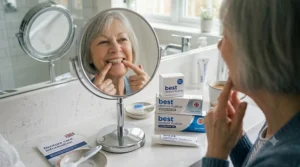
This guide rounds up the best denture fixative options available on Amazon.co.uk in 2026, from no-nonsense classic creams to zinc-free powders that won’t leave a residue on your palate. We’ve dug through real denture adhesive reviews, compared formats, and weighed up which products genuinely earn their place in a UK bathroom cabinet — as opposed to one that just photographs well on a product page. There’s no single “best” for everyone; a lot depends on whether you’ve got a full or partial denture, how your gums have changed shape, and frankly how much faff you can tolerate before your morning coffee. We’ll help you work out which one’s yours.
A quick note before we dive in: fixative is a helper, not a fix. If your dentures genuinely don’t fit, no amount of cream is going to solve that — your dentist will. More on that later.
Quick Comparison Table
| Product | Format | Best For | Price Range (Amazon.co.uk) |
|---|---|---|---|
| Fixodent Complete | Cream | Everyday all-rounder | £3–£10 (multipacks) |
| Poligrip Power Max | Cream | Strongest hold, food sealing | £4–£9 |
| Super Poli-Grip Powder | Powder | Sensitive gums, light feel | £8–£13 |
| Seabond Fixative Seals | Cushion strips | Mess-free, on-the-go use | £8–£13 |
| Polident Corega Ultra Powder | Powder | Zinc-free, partial dentures | £3–£8 |
| Cushion Grip | Thermoplastic | Loose or ill-fitting dentures | £8–£14 |
| NaturDent | Cream | Natural, zinc-free, vegan | £14–£18 |
A few things jump out once you line these up side by side. Creams dominate the market because they’re cheap and versatile, but the powders and Seabond strips earn their higher price tag by being far less messy for anyone with dexterity issues. NaturDent sits at the premium end largely because it’s a niche, imported, pine-resin formula rather than a mass-market chemical adhesive — you’re paying for the ingredient story as much as the hold. None of these are exact prices (Amazon shifts them weekly), so treat the ranges as a sensible ballpark rather than gospel. One more UK-specific reassurance: buying online still gives you statutory protection — under the Consumer Contracts Regulations, most goods bought from Amazon.co.uk come with a 14-day cooling-off period if a product turns out to be wrong for you.
💬 Just one click — help others make better buying decisions too! 😊
✨ Don’t Miss These Exclusive Deals!
🔍 Take your denture comfort to the next level with these carefully selected products. Click on any highlighted item to check current pricing and availability on Amazon.co.uk — these picks will help you find exactly what suits your dentures.
Top 7 Denture Fixatives: Expert Analysis
1. Fixodent Complete
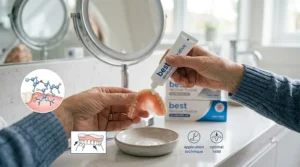
Fixodent Complete is the denture cream most British bathroom cabinets have seen at some point — it’s the brand even non-denture-wearers somehow recognise. The formula uses a copolymer that swells slightly on contact with saliva, sealing gaps and holding for most of the day on a single application; in practice that means it copes fine with a roast dinner but might need topping up before a long evening out. What most buyers overlook is that a little genuinely goes a long way — a pea-sized amount per ridge, not the generous swirl shown in adverts.
It’s an obvious fit for first-time wearers who want a reliable, low-cost starting point before working out their own preferences, and for anyone who just wants a fixative that does its job without ceremony. UK reviewers consistently praise the hold-to-price ratio, with the most common gripe being that the nozzle makes precise application tricky until you get the knack of it.
✅ Cheap and widely stocked
✅ Strong, dependable hold for full days
✅ Mild flavour that doesn’t fight with food
❌ Can ooze if over-applied
❌ Contains zinc (avoid if you’re using large amounts daily)
Multipacks typically run £3–£10 depending on size — among the best value-for-money options in this whole list.
2. Poligrip Power Max
Poligrip Power Max leans hard into the “food seal” side of things, which makes sense given GSK’s long history with the Poligrip name. The cream is flavour-free rather than minty, a small detail that matters more than it sounds if you’re sensitive to artificial flavours lingering through your first cup of tea. In British testing terms, this is the one to reach for if your problem is specifically food working its way under the denture rather than the denture itself slipping.
It particularly suits people who eat a lot of fibrous or crumbly food — think jacket potatoes, crusty bread, the entire concept of a Sunday roast — where the seal matters more than raw adhesive strength. Customer feedback on Amazon.co.uk is largely positive, with the main criticism being that the tube empties faster than expected if you’re generous with it.
✅ Excellent at blocking food particles
✅ Taste-free formula
✅ Strong daytime hold
❌ Premium pricing compared to Fixodent
❌ Some users find the texture a touch thick to spread evenly
Expect to pay £4–£9 for a standard tube, with savings on multipacks.
3. Super Poli-Grip Extra Strength Powder
Powders are the unsung format of the denture world, and Super Poli-Grip Extra Strength Powder is the one most UK pharmacies still quietly recommend for sensitive gums. Rather than a thick cream layer, you get a fine dusting that swells minimally — which means less bulk pressing against sore spots, something anyone with thinning gum tissue will appreciate immediately. The trade-off, predictably, is a slightly shorter hold window than the heavier-duty creams.
This is the pick for anyone whose dentures fit reasonably well already and just wants a confidence boost rather than a structural prop — or for people who’ve tried creams and found the texture unpleasant. It’s a bit fiddly the first few times (shaking on the right amount takes practice), but most reviewers say they wouldn’t switch back once they’ve adjusted.
✅ Light, low-bulk feel
✅ Gentle on sensitive or sore gums
✅ Easy to control thickness once practised
❌ Shorter hold than premium creams
❌ Powder mess if applied indoors near dark clothing
Pricing tends to sit around £8–£13 for a multipack.
4. Seabond Denture Fixative Seals
Seabond Denture Fixative Seals are the pre-cut cushion pads that solve the single biggest complaint about creams: the mess. You wet the pad, press it onto the denture, trim if needed, and you’re done — no nozzle, no oozing, no scrubbing dried adhesive off your fingers before a meeting. For anyone with arthritis or limited hand dexterity, that’s not a minor convenience; it’s the difference between managing independently and needing help every morning.
They genuinely shine for travel and for anyone who finds creams unpredictable in terms of how much to use. The trade-off is cost per use, since pre-cut pads work out pricier gram-for-gram than tubes, and the hold, while solid, rarely matches a thick cream layer for an all-day marathon.
✅ Virtually mess-free application
✅ Brilliant for travel or limited dexterity
✅ Helps seal out food without oozing
❌ Higher cost per use than creams
❌ Less adjustable than liquid formats for irregular gum shapes
Packs run £8–£13, depending on quantity.
5. Polident Corega Ultra Adhesive Powder
If “zinc-free dental adhesive” is on your shopping checklist, Polident Corega Ultra Adhesive Powder is one of the most widely available zinc-free options on Amazon.co.uk, and it’s particularly well suited to partial dentures where there’s less surface area to work with. The fine powder format means it sits comfortably against natural teeth without the gumminess some creams produce around metal clasps.
What most people don’t realise about partial dentures specifically is that bulky cream adhesives can actually interfere with the clasp fit — a powder avoids that entirely, which is why dental technicians often quietly favour it for partial cases. UK reviewers rate it well for all-day confidence without a heavy “glued in” sensation.
✅ Zinc-free formula
✅ Works well around partial denture clasps
✅ Light, comfortable feel
❌ Less effective on very loose full dentures
❌ Requires careful shaking to avoid clumping
Typical pricing is £3–£8, making it one of the more affordable zinc-free options.
6. Cushion Grip Thermoplastic Denture Adhesive
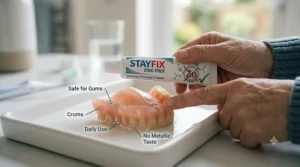
Cushion Grip isn’t really an adhesive in the traditional sense — it’s a thermoplastic that you warm slightly and mould directly onto the denture, creating a soft, custom-fit cushion that can last several days rather than hours. It’s the closest thing to a temporary soft reline you can buy without booking a dentist appointment, and it’s the product most often recommended in UK denture forums for dentures that have become genuinely loose rather than just slightly insecure.
This one’s for the person whose gums have shrunk noticeably and who needs a bridge solution while waiting for a reline or a new set — not a daily-cream replacement for well-fitting dentures. It takes a bit of practice to mould evenly the first time, but once you’ve got the technique, it’s remarkably effective at filling gaps creams simply can’t.
✅ Lasts multiple days per application
✅ Cushions sore spots from loose-fitting dentures
✅ Zinc-free and waterproof
❌ Fiddlier to apply correctly than cream or powder
❌ Not a substitute for an actual dental reline if the fit issue is severe
Expect £8–£14 per pack, which is reasonable given the multi-day use.
7. NaturDent Denture Adhesive
NaturDent is the outlier on this list — a pine-resin-based, vegan, zinc-free formula aimed squarely at people who want to avoid synthetic ingredients altogether. It contains polyvinyl acetate, the same family of compound used in classic wood glue, which understandably raises eyebrows, though it’s a standard food-grade-rated polymer rather than anything alarming. The hold is solid rather than spectacular, but the appeal here is ingredient transparency over raw adhesive strength.
It suits health-conscious buyers and anyone who’s had reactions to mainstream adhesive chemicals and wants a genuinely different formulation rather than just a different brand of the same thing. It’s imported, which explains the steeper price, but reviewers who’ve made the switch tend to stick with it.
✅ Vegan and zinc-free
✅ Natural pine-resin base
✅ No artificial taste
❌ Premium import pricing
❌ Less widely available than the big three brands
Pricing runs £14–£18, noticeably above the mainstream creams.
Top 7 Products: Side-by-Side Specifications
| Product | Zinc-Free | Format | Hold Duration | Best Denture Type |
|---|---|---|---|---|
| Fixodent Complete | No | Cream | Up to all day | Full |
| Poligrip Power Max | No | Cream | Up to all day | Full |
| Super Poli-Grip Powder | No | Powder | 6–10 hours | Full or partial |
| Seabond Fixative Seals | Yes | Cushion strip | 8–12 hours | Full |
| Polident Corega Ultra Powder | Yes | Powder | All day | Partial |
| Cushion Grip | Yes | Thermoplastic | 2–4 days | Loose-fitting |
| NaturDent | Yes | Cream | All day | Full or partial |
Looking at this table, the split between “zinc-free” and “not zinc-free” tracks fairly closely with whether a product is a legacy mass-market brand or a newer, smaller player — the bigger names have been slower to reformulate. If your dentist has specifically advised avoiding zinc, your shortlist narrows quickly to Seabond, Corega, Cushion Grip, and NaturDent. For raw all-day staying power on a properly fitted denture, the two cream heavyweights — Fixodent and Poligrip — still edge ahead in most UK reviews.
Real-World Scenarios: Who Should Use What
Picture a retired teacher in a village outside Bath, dentures fitted eighteen months ago, mostly comfortable but occasionally loose by teatime. A light powder like Super Poli-Grip or Polident Corega Ultra suits this profile well — minimal bulk, just enough confidence to get through a long lunch without worrying.
Now picture someone in their first month of wearing immediate dentures after extractions, still figuring out the basics. A reliable, budget cream such as Fixodent Complete is the sensible starting point — affordable enough to experiment with quantity while you learn your own ridge shape.
And consider someone whose gums have shrunk significantly over several years and who’s waiting on an NHS appointment for a reline. Cushion Grip bridges that gap properly, cushioning sore spots in a way no cream can, while they wait their turn in the system.
Practical Usage Guide: Denture Retention Tips That Actually Work
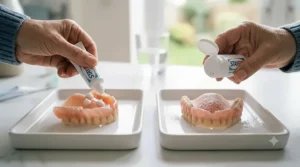
Getting the most from any fixative comes down to a handful of habits dentists repeat constantly, and most denture retention tips boil down to the same few principles. Clean and fully dry the denture before applying anything — moisture stops adhesives bonding properly. Use less than you think you need; a thin, even line or light dusting almost always outperforms a thick blob, which just oozes out and wastes product. Press and hold for a few seconds rather than biting down hard immediately, giving the adhesive time to set against the gum.
Remove fixative residue every night rather than layering fresh adhesive over old — a soft brush and warm (not hot) water does the job without damaging the denture material. And if you’re finding you need more and more adhesive each week just to get through the day, that’s not a sign you’ve found the wrong product; it’s a sign your denture fit has changed and a dental check-up is overdue.
How Denture Adhesive Actually Works
Most people assume fixative just “glues” the denture to the gum, but the chemistry is a bit cleverer than that. The adhesive absorbs saliva and swells into a soft, elastic gel that fills the microscopic gaps between denture and gum tissue, creating natural suction rather than a permanent bond. That’s why dentures with fixative still come out easily at night — and why a denture that’s genuinely the wrong shape will eventually defeat even the strongest adhesive, because there’s simply too much gap for the gel layer to bridge.
Denture Fixative Cream vs Powder: Which Format Wins?
The denture fixative cream vs powder debate comes down to bulk versus precision. Cream gives a thicker, more forgiving layer that’s better at filling larger gaps and tends to hold longest — ideal for full dentures with noticeable looseness. Powder gives a thinner, lighter layer that’s gentler on sore or sensitive gums and works better around the clasps of a partial denture, but it generally needs reapplying sooner.
Neither is objectively “better” — it’s a question of fit. If your denture is reasonably secure and you just want extra confidence, powder usually wins. If your denture has more obvious movement, cream’s thicker gap-filling tends to serve you better until you can get a proper reline sorted.
Common Mistakes When Buying and Using Denture Adhesive
The most common mistake is treating fixative as a permanent fix for a denture that no longer fits, rather than what it actually is: a temporary bridge while you sort out the real solution with your dentist. Close behind is over-application — squeezing out far more than needed in the hope of a stronger hold, which mostly just creates mess and, with zinc-containing products, raises the (rare but real) risk discussed below.
A less obvious mistake is sticking rigidly to one brand out of habit rather than matching the format to your specific denture type — full dentures and partial dentures genuinely benefit from different products, as the comparison table above shows. And plenty of UK buyers default to whichever cream is cheapest on the shelf without checking whether a zinc-free alternative might suit their gums better, especially if they’re using adhesive daily over the long term. If you’re ever unsure which type suits your specific denture, the British Dental Association and your own dentist remain the best port of call — a five-minute chat can save months of trial and error with the wrong product.
The Zinc Question: What UK Buyers Should Know
This is worth addressing directly because it occasionally makes headlines. Some traditional denture creams contain small amounts of zinc to help adhesion, and research has linked chronic, heavy overuse — going through a tube every couple of days rather than the recommended thin daily layer — to copper deficiency and, in rare cases, nerve damage. A peer-reviewed case report has documented copper deficiency myelopathy potentially linked to overuse of zinc-containing denture adhesive, and similar findings have prompted ongoing regulatory discussion around labelling.
The important context here is “overuse” — using a normal, instructed amount of a zinc-containing cream isn’t the issue; using several tubes a week, every week, for years is. If that sounds at all like your own usage pattern, it’s worth a chat with your dentist about why you’re needing so much, since it usually points to a denture that needs refitting rather than a product that needs replacing. If you’d simply rather avoid zinc altogether as a precaution, Seabond, Polident Corega, Cushion Grip, and NaturDent are all zinc-free routes covered above.
Long-Term Cost & Maintenance in the UK
Run the numbers over a year and the differences between formats start to matter more than the shelf price suggests. A budget cream used sensibly might cost £25–£40 annually; premium creams or powders with smaller tube sizes can creep towards £60–£90 if you’re a heavier user; and Seabond’s pre-cut pads, while convenient, tend to land at the upper end of that range simply because pre-cut format costs more per gram than bulk cream or powder.
The genuinely cost-saving move, longer term, isn’t switching brands — it’s addressing why you need adhesive at all. The Oral Health Foundation has published guidelines for dental professionals, caregivers and patients on the optimal use of denture adhesive creams, and one of their core points is that adhesive works best — and is needed least — when paired with well-fitting dentures and regular dental check-ups, not as a permanent crutch for ones that have drifted out of shape.
How to Choose the Best Denture Fixative in the UK
- Identify your denture type first. Full and partial dentures respond differently to bulk — partials generally do better with powder.
- Check for zinc if you’re a daily, long-term user. Heavy, sustained use is where zinc-related risk actually applies.
- Match format to dexterity. Strips and pads suit limited hand mobility; cream and powder suit anyone comfortable with a bit of mess.
- Think about hold duration versus your day. A long shift or evening out calls for a stronger cream; a quiet day at home might only need a light powder.
- Factor in delivery and stock. Amazon.co.uk Prime members typically get next-day delivery on the major brands, useful if you’re down to your last tube.
- Don’t ignore persistent looseness. If you’re needing more adhesive every week, that’s a fit problem, not a product problem — book a dentist visit.
- Budget for the year, not the tube. A slightly pricier zinc-free option can work out similar annually if it means using less per application.
Frequently Asked Questions
❓ What is the best denture fixative for everyday use?
❓ Is it safe to use denture adhesive every day?
❓ Do I need a prescription for denture fixative in the UK?
❓ Will Amazon UK deliver my denture fixative next day?
❓ Should I use cream, powder, or strips for a partial denture?
✨ Don’t Miss These Exclusive Deals!
🔍 Whichever format suits your dentures, these picks are all worth a look on Amazon.co.uk before you commit to a tube. Compare current pricing and availability, and pick the one that matches your denture type and budget.
Conclusion
There’s no single best denture fixative — only the one that matches your denture type, your gums, and how much mess you’re willing to tolerate before breakfast. If you want a dependable, affordable daily cream, Fixodent or Poligrip will serve you well. If zinc-free matters to you, Seabond, Polident Corega, Cushion Grip, and NaturDent all cover that ground from different angles. And if your dentures have become genuinely loose rather than just occasionally insecure, no adhesive — however good — replaces a conversation with your dentist about a reline.
Whatever you choose, treat fixative as a confidence boost rather than a permanent solution, use less than you think you need, and clean it off properly every night. Your gums, and your dentist, will thank you for it.
Recommended for You
- Best Antibacterial Denture Cleaner UK 2026: Top 7 That Kill Bacteria Fast
- Denture Brush vs Regular Toothbrush: 7 Best UK Picks 2026
- Best Denture Brush UK 2026: 7 Expert Picks for Sparkling Clean False Teeth
Disclaimer: This article contains affiliate links. As an Amazon Associate, I earn from qualifying purchases. If you purchase products through these links, we may earn a small commission at no additional cost to you.
✨ Found this helpful? Share it with your mates! 💬🤗
