

In This Article
Oral probiotic strains explained in plain terms: they are specific, named bacteria, such as Streptococcus salivarius K12 and M18 or Lactobacillus reuteri DSM 17938, delivered in lozenges, chewables or drops so they can temporarily settle in your mouth and support a balanced oral microbiome alongside brushing, not instead of it.

Here’s the thing the supplement aisle rarely admits: “probiotic” is a surname, not a first name. Saying you take a probiotic is like saying you drive a vehicle. It could be a milk float or a Ferrari. A Lactobacillus reuteri strain trialled on gum bleeding has little in common, evidence-wise, with a random Lactobacillus in a gut capsule. (Worth knowing: the species was formally reclassified as Limosilactobacillus reuteri in 2020, but labels still use the old name.) The strain is the product.
That’s why this oral probiotic supplement guide starts with the bugs, not the branding. We compare seven real products you can look for on Amazon UK, unpack what each strain has actually been studied for, and walk through choosing an oral probiotic that fits your habits, budget and patience for slow-dissolving lozenges. Every verdict rests on label specs and published or aggregated review sentiment. None of it is hands-on testing, and where the evidence is thin, we say so.
A quick expectation-setter. Oral flora balance is a long game, and brushing twice daily with fluoride toothpaste still does the heavy lifting. Prices below are ranges only, and Amazon UK availability shifts, so check current price, seller and expiry date before you buy.
Quick Comparison: 7 Oral Probiotics at a Glance
Think of this table as the menu before the tasting notes. Strains are listed because they, not the logo, decide what you are really buying.
| Product | Key strain(s) | Form | Price range (indicative) | Best For |
|---|---|---|---|---|
| NOW Foods OralBiotic | S. salivarius K12 | Lozenge, 60-count | Under £25 | Budget K12 trial |
| HealthAid OralProbio | K12 + M18 | Lozenge, 30-count | £15-£25 | UK-made dual-strain routine |
| Bactoblis | S. salivarius K12 | Bedtime lozenge | £15-£25 | Evening K12 routine |
| Life Extension FLORASSIST Oral Hygiene | M18 + heat-treated L. plantarum L-137 | Lozenge, 30-count | £15-£25 | Plaque-minded M18 fans |
| Hyperbiotics PRO-Dental | Four-strain blend + zinc | Mint chewable, 45-count | £20-£30 | People who prefer chewables |
| BioGaia Prodentis | L. reuteri DSM 17938 + ATCC PTA 5289 | Mint lozenge, 30-count | £25-£35 | Gum-focused, evidence-led buyers |
| BioGaia Prodentis Kids | L. reuteri | Apple lozenge | £20-£30 | Families with children |
Looking at the comparison above, OralBiotic is the cheapest way to sample K12. HealthAid OralProbio and FLORASSIST bring M18 into the mix for people whose priority is plaque rather than throat or breath. Prodentis costs more, but it is the only pick here built on Lactobacillus reuteri, where the deepest gum-health trial data sits. PRO-Dental is the lone chewable, and Prodentis Kids is the family option. Treat every price band as a snapshot, because sellers and pack sizes vary.
💬 Just one click — help others make better buying decisions too!😊
Top 7 Oral Probiotic Supplements: Expert Analysis of the Strains Inside
Ordered roughly from budget-friendly to premium. Each verdict is built from label data and aggregated review sentiment, never invented quotes or personal testing.
1. NOW Foods OralBiotic — Cheapest way to try K12
OralBiotic is the low-risk gateway to Streptococcus salivarius K12, the strain behind most “BLIS” lozenges. On the manufacturer’s label, two lozenges carry 42 mg of K12, listed as 1 billion CFU, so a 60-lozenge tub is 30 servings. That arithmetic matters. US-market directions allow up to four servings a day, which would empty a tub in about a week. Read the directions on your UK pack and work out cost per day before clicking. The label also advises keeping antibiotics at least two hours away, because antibiotics may inactivate the strain.
Based on the spec comparison, this suits first-timers who want to see whether a K12 habit fits their evening without paying premium prices. What the spec sheet won’t tell you is how it tastes or dissolves. Verified customer feedback was thin: the retailer comments found mostly praised delivery speed. So the case for this one rests on the strain’s reputation, not on the brand’s review pool.
Pros:
- ✅ Genuine K12 dose, 1 billion CFU per serving
- ✅ Big 60-lozenge tub for the money
- ✅ Familiar strain with a long safety record
Cons:
- ❌ No M18 or reuteri for plaque or gum focus
- ❌ Little verified review data to lean on
Price: roughly the high-£10s to low-£20s range, so check current price. Solid value as a trial run.

2. HealthAid OralProbio — K12 and M18 in one UK-made lozenge
Two strains, one lozenge: that’s the pitch. OralProbio lists 1 billion CFU each of K12 and M18, sweetened with xylitol and flavoured with natural peppermint, vegan-friendly, in packs of 30, and the brand says it is made in England. The brand suggests one lozenge daily on an empty stomach, preferably in the morning. That differs from the bedtime timing some K12 brands recommend, so follow the directions printed on your pack.
Here’s what to weigh. K12 has the stronger research record, while M18’s evidence is thinner and often studied alongside K12, according to a UK pharmacy guide. Pairing them is a sensible hedge if you can’t decide whether breath or plaque is your bigger worry. Innerbody’s testers liked the K12-plus-M18 combination and found the flavour pleasant but not class-leading. They also felt a higher dose might have earned a stronger recommendation. That’s their editorial view, not a clinical threshold.
Pros:
- ✅ Two complementary strains in one daily lozenge
- ✅ Xylitol-sweetened and vegan-friendly per the brand
- ✅ Made in England, handy for UK buyers
Cons:
- ❌ Dose judged modest by some independent testers
- ❌ Tasty, but not the best flavour in the group
Price: about £15-£25 for a 30-lozenge pack at the time of research. Fair value for a dual-strain option.
3. Bactoblis — The K12 lozenge with UK trial pedigree
Bactoblis has something rare in this category: a UK academic study built around it. The University of Southampton’s BLIS study used Bactoblis lozenges, supplied by Bluestone Pharma, to compare two dosing regimens. Group A took two lozenges at night on days 1, 7 and 14, while Group B took one nightly for 14 days. The aim was to see how long K12 colonisation lasts. That is a feasibility study of compliance and colonisation, not proof of benefit, but it shows researchers consider the dosing question worth asking.
Retail listings for the Starmel version describe 1 billion CFU of K12 per lozenge at bedtime, with advice to avoid drinking afterwards. Some versions add vitamin D3, so read the exact listing you’re buying. Reviews on Greek retail pages were anecdotal and sore-throat-focused, and I couldn’t verify Amazon UK reviews. UK stock varies by seller, so check the expiry date and the seller.
Pros:
- ✅ K12 with a documented UK research connection
- ✅ Simple one-lozenge bedtime routine
- ✅ Strain’s safety record spans thousands of participants
Cons:
- ❌ UK availability and listings are inconsistent
- ❌ Anecdotal reviews only, mostly throat-related
Price: typically in the £15-£25 range, so check current price. Good value if you can find a trustworthy seller.
4. Life Extension FLORASSIST Oral Hygiene — M18 plus a heat-treated postbiotic
FLORASSIST takes a different route. Each vegetarian lozenge pairs 25 mg of M18 (providing 2.5 billion CFU) with 50 mg of heat-treated Lactobacillus plantarum L-137, a “postbiotic” that is inactivated rather than alive. The label suggests one lozenge daily after brushing, flavoured with spearmint and cherry and sweetened with xylitol and mannitol. In practice, that’s a higher M18 dose than OralProbio‘s 1 billion CFU, though dose alone doesn’t decide quality.
The honest take: M18 is the plaque-minded strain here, while the L-137 component targets local immune tone. As far as the sources reviewed show, its dental evidence is thinner than for K12 or reuteri. Innerbody’s team named it their pick for most people, which is a useful vote of confidence but not a clinical endorsement. Allergy note: one listing states it contains milk.
Pros:
- ✅ Higher M18 dose than most rivals
- ✅ Once-daily, post-brushing routine
- ✅ Vegetarian lozenge
Cons:
- ❌ Contains milk per one retailer listing
- ❌ US brand, so UK stock and expiry need checking
Price: roughly £15-£25, so check current price. Good value for the M18 dose.
5. Hyperbiotics PRO-Dental — Chewable, multi-strain and zinc-boosted
PRO-Dental is the rebel of the group: a mint chewable tablet rather than a lozenge. The brand describes four targeted, clinically studied strains plus chelated zinc, in a 45-count tub. One strain roundup names K12 and M18 among them, but check the label on your UK pack for the exact list. A chewable’s quirk is contact time. Chew and swallow, and your mouth is exposed to the bacteria for less time than with a lozenge that melts slowly. That is reasoning from the format, not a trial result.
On one retailer’s page, PRO-Dental averages 4.9 from 56 reviews. Reviewers mention a cleaner-feeling mouth, less tongue coating and help with a chronic dry mouth, though the brand itself says it can’t cure dry mouth. Small sample, retailer-hosted testimonials: encouraging, not conclusive.
Pros:
- ✅ Easy chewable format for lozenge-averse users
- ✅ Multi-strain blend with added zinc
- ✅ Very high average on a small review pool
Cons:
- ❌ Shorter mouth contact than a slow lozenge
- ❌ Fewer independent evaluations than the reuteri pair
Price: around £20-£30, so check current price. Reasonable value if you’ll actually take it.

6. BioGaia Prodentis — The most-studied Lactobacillus reuteri pair
Prodentis pairs two Lactobacillus reuteri strains, DSM 17938 and ATCC PTA 5289, in a mint lozenge sweetened with isomalt and xylitol. One EU retailer listing states it suits adults and children from 3, and may be used during pregnancy and breastfeeding. Let it melt rather than chew it, and store it no warmer than 25°C. A dental trade-magazine summary counts over 60 clinical studies in 2,355 individuals, 48 of them randomised and controlled. An independent dental writer adds a caveat: trials show reduced gum bleeding, but large long-term trials haven’t shown fewer cavities. Benefits are strain-specific, and it’s a complement to hygiene, not a replacement.
Sentiment is strong. On iHerb, Prodentis averages 4.6 from over 3,700 ratings. Reviewers praise the taste and fresh feeling, while critics find it pricey, note a lower CFU count and, on US listings, object to sucralose. The EU listing I checked names isomalt and xylitol instead, so read your pack. Innerbody’s testers rated it the best-tasting.
Pros:
- ✅ Deepest gum-health trial base among these picks
- ✅ Pleasant mint flavour, widely praised
- ✅ Label allows use in pregnancy per EU listing
Cons:
- ❌ Premium price per month
- ❌ No proof of fewer cavities
Price: about £25-£35 per 30 lozenges, so check current price. Premium, but justified for gum-focused buyers.
7. BioGaia Prodentis Kids — Apple-flavoured reuteri for families
Prodentis Kids swaps mint for apple and is built for younger mouths. An Australian retail listing describes 200 million CFU of Lactobacillus reuteri per lozenge, with xylitol and isomalt, free from gluten, lactose and milk. The adult EU product’s age guidance (from 3) differs from the kids’ listing (from 6). Age labels vary by market, so follow your pack and your dentist.
The reasoning is simple: the same research lineage as the adult lozenge, in a flavour children accept. Independent commentary suggests it may be a reasonable adjunct, not a replacement, for fluoride and diet control in higher-risk children, such as those with elevated S. mutans. I couldn’t verify meaningful customer reviews for the kids’ version, so its case leans on the adult product’s evidence. Don’t give any probiotic to a child without your dentist’s go-ahead, especially under school age.
Pros:
- ✅ Child-friendly apple flavour
- ✅ Same L. reuteri research lineage as the adult version
- ✅ Free from gluten, lactose and milk per listing
Cons:
- ❌ Fewer verified reviews or child-specific trials
- ❌ UK Amazon availability uncertain
Price: around £20-£30, so check current price. Worth it if a dentist recommends a probiotic for your child.
Oral Probiotic Strains Explained: K12, M18 and Lactobacillus reuteri Compared
Every product above is really a strain choice in a nicer outfit. Streptococcus salivarius is typically among the first bacteria humans acquire in infancy, so K12 is arguably the “home team” player. It produces bacteriocin-like substances aimed at odour-producing and pathogenic bacteria. M18 works by competing with unwanted species. Lactobacillus reuteri is a different animal: a lactic acid bacterium found in the gut, breast milk and fermented foods, which can make the antimicrobial compound reuterin from glycerol.
| Strain | Found in | Main idea | Evidence picture | Best For |
|---|---|---|---|---|
| S. salivarius K12 | OralBiotic, OralProbio, Bactoblis | Bacteriocin-like activity against odour-producing bacteria | Small trials show modest breath improvements; colonisation temporary | Breath and throat-minded buyers |
| S. salivarius M18 | OralProbio, FLORASSIST | Competitive exclusion of unwanted bacteria | Thinner data, often studied with K12 | Plaque-minded buyers |
| L. reuteri DSM 17938 + ATCC PTA 5289 | Prodentis, Prodentis Kids | Supports gum tissue and microbial balance | Multiple RCTs on gum bleeding; no proof on cavities | Gum-focused buyers |
| Heat-treated L. plantarum L-137 | FLORASSIST | Postbiotic; supports local immune tone | Thinner dental evidence | Curious experimenters |
| Four-strain blend + zinc | PRO-Dental | Broad coverage plus zinc | Mostly brand and retailer data | Chewable fans |
Reading the table, K12 and L. reuteri have the strongest “named-strain” stories, but they target different jobs. K12 leans towards breath and throat, reuteri towards gums. M18 is a sensible add-on rather than a stand-alone bet. If you can only afford one strain, match it to your goal, not the packaging.
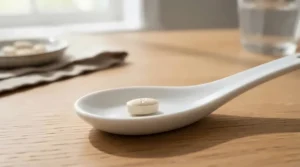
Supplement Form Factors: Lozenges, Chewables, Drops and Toothpaste
Supplement form factors matter more than most buyers realise, because an oral probiotic only works while it is in your mouth. A lozenge that dissolves slowly bathes your teeth and gums for minutes, whereas a chewable gets swallowed faster. Drops, used chairside by dental professionals, can be placed precisely. Probiotic toothpastes and rinses are emerging formats, but they spend only seconds in contact.
| Form | Contact time | Convenience | Best For |
|---|---|---|---|
| Lozenge | Longest (melts slowly) | Easy at bedtime | Most people |
| Chewable tablet | Short | Very easy, no waiting | Lozenge-averse adults |
| Drops | Targeted | Needs technique | Dental-chair use |
| Toothpaste or rinse | Seconds | Slots into routine | Add-on, not stand-alone |
The analysis is simple: lozenges win on contact time, which is why most picks here use that format. PRO-Dental trades contact time for convenience, while Prodentis and FLORASSIST reward patience. Don’t chew a lozenge if the pack says to let it melt.
How to Choose an Oral Probiotic: 6 Steps
Choosing an oral probiotic is easier when you work backwards from your goal.
- Define your goal. Is it breath, gums, plaque or general maintenance? Different strains have different evidence.
- Match strain to goal. K12 for breath and throat, L. reuteri for gums, M18 for plaque. Don’t expect cross-over.
- Read the strain code. Look for specifics like “DSM 17938” or “BLIS K12”, not just “Lactobacillus blend”.
- Pick a form you’ll use daily. A perfect lozenge you skip beats an imperfect chewable you take.
- Check allergens and sweeteners. Milk in FLORASSIST, xylitol (toxic to dogs) and regional sweetener differences all matter.
- Compare cost per day, not per tub. A 60-count tub can be 30 servings or 7 days depending on dose.
Before buying on Amazon UK, confirm the seller, expiry date and storage conditions.
What to Expect: Oral Flora Balance in the Real World
Oral flora balance isn’t a switch you flip. Evidence suggests colonisation is temporary, and benefits may fade once you stop. Southampton’s study design, which tracks colonisation at several time points, exists precisely because duration is an open question. For gums, trials of the reuteri pair have reported reduced bleeding, but that’s different from promising a cure. For breath, small K12 trials show modest improvements. For cavities, large long-term proof is still missing.
So what does “working” look like? Perhaps fresher-feeling mornings, or less bleeding after flossing over several weeks, alongside better habits. If gum bleeding persists, see your dentist. A probiotic is not a diagnosis.
Oral Probiotics vs Traditional Oral Care
Traditional care isn’t going anywhere. NHS Wales advice on looking after your teeth and gums still centres on brushing twice daily with fluoride toothpaste, cleaning between teeth, cutting sugar and visiting your dentist regularly.
| Option | Main job | Evidence strength | Best For |
|---|---|---|---|
| Fluoride toothpaste | Prevents decay, removes plaque | Strongest | Everyone |
| Interdental cleaning | Cleans where brushes can’t reach | Strong | Everyone |
| Antimicrobial mouthwash | Short-term bacterial reduction | Moderate, at a different time to brushing | Specific, dentist-advised needs |
| Oral probiotic lozenge | Supports microbial balance | Strain-dependent, emerging | Adults wanting an add-on |
Probiotics are the supporting act, never the headliner. Their best use is as an extra layer for people already nailing the basics. If your routine has gaps, fix those first.
Safety, Regulations and Who Should Ask First
Probiotic lozenges are food supplements, not medicines, so UK labels use cautious wording like “supports” or “maintains” rather than “treats”. To my knowledge, authorised health claims for probiotics remain limited in Great Britain, so treat bolder marketing with scepticism. Practical cautions: take K12 products at least two hours apart from antibiotics, check allergen statements (one listing states FLORASSIST contains milk), and keep xylitol-containing lozenges away from dogs. If you are immunocompromised, pregnant or giving a probiotic to a child, ask your dentist or pharmacist first. Labels differ by market, so rely on the pack in your hand.

Long-Term Cost: What a Month and a Year Really Cost
Using the indicative bands above, a 30-day supply runs roughly £15-£35, or about 50p to just over £1 per day. Over a year, that’s around £180-£420. OralBiotic looks cheap, but its dose maths could change that if you use several servings daily. Prodentis costs more upfront but has the deepest gum-health evidence. The value question isn’t “cheapest?” but “does the strain match my goal, and will I stick with it for months?” Prices and pack sizes change, so check current price before committing.
Oral Probiotic Supplement Guide: Your First 30 Days
Here’s a practical routine, built from label directions and UK dental guidance.
Days 1-3: set the foundations. Brush for two minutes with fluoride toothpaste, ideally 1350-1500 ppm, and spit without rinsing, as SDCEP’s gum health information recommends. Clean between teeth.
Days 1-30: add the lozenge. Take it after your usual oral routine, let it dissolve, and avoid eating or drinking straight afterwards. Use mouthwash at a different time of day.
Common first-month mistakes:
- Chewing a lozenge meant to melt
- Rinsing immediately afterwards
- Taking it alongside antibiotics
- Quitting after ten days
- Storing it somewhere warm (keep it below about 25°C)
Check the pack for a “use within” window after opening.
Real-World Scenarios: Which Oral Probiotic Fits Which Life
The budget commuter. £20 a month, coffee-heavy mornings, breath worries. OralBiotic or HealthAid OralProbio fits, with K12 as the headline strain. Daily use, bedtime or per label.
The gum-conscious 50-something. Gums bleed when flossing, and the dentist is already involved. Prodentis has the strongest trial base for that goal, as an adjunct to hygienist advice. Budget: £25-£35 monthly.
The family with school-age children. Prodentis Kids is the natural candidate, but only after checking age guidance and speaking to your dentist. Parents might pair it with adult Prodentis.
✨ Ready to Find Your Strain?
🔍 Take your oral flora balance to the next level with these carefully selected products. Click any highlighted product to check current pricing and availability on Amazon UK. Match the strain to your goal, and you’ll build a routine that actually sticks!
Problem to Solution: Fixing Common Oral Probiotic Snags
The lozenge dissolves too slowly or tastes chalky. Try taking it after brushing at a quieter moment, or consider PRO-Dental‘s chewable.
Sweetener worries. US versions of some products use sucralose, whereas the EU Prodentis listing names isomalt and xylitol. Sugar alcohols can upset some stomachs in larger amounts, so start with the labelled dose.
You’re on antibiotics. Keep K12 products at least two hours apart.
No change after four to six weeks. Don’t escalate doses. Book a dental check-up, because persistent bleeding or odour needs a professional look.
You have a dog. Store xylitol lozenges out of reach.

FAQ
❓ Do oral probiotics work for bad breath?
❓ How long do the benefits last after you stop?
❓ Are oral probiotic lozenges vegan-friendly?
❓ Is a probiotic toothpaste better than a lozenge?
❓ Can I buy oral probiotic supplements on Amazon UK safely?
Conclusion
So, oral probiotic strains explained in one line: the strain is the product. OralBiotic, HealthAid OralProbio and Bactoblis put K12 front and centre for breath and throat. FLORASSIST leans on M18 for plaque-minded buyers, and PRO-Dental serves anyone allergic to waiting for lozenges to melt. Prodentis carries the strongest gum-health evidence via Lactobacillus reuteri, and Prodentis Kids brings that lineage to families, with a dentist’s blessing.
Remember the guardrails. Oral flora balance is gradual, benefits appear strain-specific, and cavity prevention remains unproven. Fluoride toothpaste, interdental cleaning and regular dental visits remain the foundation. If you’re choosing an oral probiotic this month, match strain to goal, pick a form you’ll use, compare cost per day, and confirm the seller and expiry date on Amazon UK before ordering.
Recommended for You
- Probiotic Lozenges For Bad Breath: 7 Best Picks For UK Buyers (2026)
- Probiotic Mints Vs Probiotic Lozenges: 7 Best Picks (2026)
- Affordable Dental Probiotic Supplements: 7 Best Value Picks (2026)
Disclaimer: This article contains affiliate links. As an Amazon Associate, I earn from qualifying purchases. If you purchase products through these links, we may earn a small commission at no additional cost to you.
✨ Found this helpful? Share it with your friends! 💬🤗
