
In This Article
There comes a moment — usually about 20 minutes into a roast dinner — when you realise your dentures have developed opinions of their own. They shift. They slip. The Yorkshire pudding becomes an adversary. And suddenly, the question of denture adhesive powder vs cream stops being abstract and becomes extremely, personally urgent.
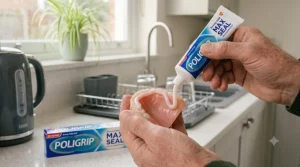
Here’s the thing: both powder and cream adhesives genuinely work. But they work differently, for different people, in different situations. Picking the wrong one doesn’t just mean mild inconvenience — it can mean sticky pink residue on your gums at 9pm, or a mouthful of loose teeth at a family gathering. Neither is ideal.
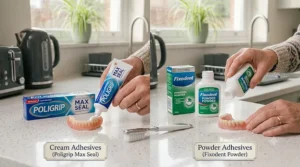
In simple terms, denture adhesive powder is sprinkled onto moistened denture surfaces where it absorbs saliva, swells, and forms a thin adhesive layer. Cream adhesive is applied in small dots or strips directly onto dry dentures, expanding on contact with mouth moisture to create a thicker, cushioning seal. As peer-reviewed guidance in the Dental Update journal explains, both types work by obliterating the space between denture and mucosa — but cream tends to distribute more uniformly, while powder creates a thinner, often easier-to-clean layer.
This guide cuts through the marketing fluff and tells you exactly what works, for whom, and why — with seven real products verified available on Amazon.co.uk, tested feedback from UK buyers, and the kind of practical advice your dentist probably didn’t have time to give you. Whether you’re newly fitted or a long-time denture wearer quietly wondering if there’s something better out there, you’re in the right place.
Quick Comparison: Powder vs Cream at a Glance
| Feature | Powder | Cream |
|---|---|---|
| Application | Sprinkled onto wet dentures | Dotted onto dry dentures |
| Hold Strength | Good–Very Good | Very Good–Excellent |
| Food Seal | Moderate | Strong |
| Cleanup | Easy — rinses off cleanly | More effort; can leave residue |
| Cushioning Effect | Minimal | Noticeable |
| Mess Factor | Low (if applied carefully) | Can ooze if over-applied |
| Best For | Upper plates, light users | Lower plates, heavy chewers |
| Zinc-free Options | Yes (Corega Ultra) | Yes (Poligrip Power Max) |
The table above tells a clear story: if clean removal and simplicity are your priorities, powder has a meaningful edge. If you need maximum hold — particularly for lower dentures, which get no suction assistance from the palate — cream wins on outright grip. That said, the gap narrows considerably with modern powder formulations, and for upper plates especially, several UK buyers report powder holding just as confidently through a full day. The “right” choice often comes down less to objective performance and more to the specific shape of your mouth, your saliva production, and frankly, how much you fancy scrubbing your gums at bedtime.
💬 Just one click — help others make better buying decisions too! 😊
✨ Don’t Miss These Exclusive Deals!
🔍 Take your denture confidence to the next level with these carefully selected products. Click any highlighted item to check current pricing and availability on Amazon.co.uk.
Top 7 Denture Adhesive Powder & Cream Products: Expert Analysis
1. Fixodent Extra Hold Denture Adhesive Powder
Fixodent’s Extra Hold powder is the one UK buyers keep coming back to — and with good reason. The formula is built around a fine-grain powder that adheres evenly across both upper and lower plates, activating quickly on contact with mouth moisture to form a hold that, for many wearers, genuinely lasts a full day on a single application.
The 76g (2.7oz) container isn’t exactly pocket-sized, but it’s good value — you use less than you’d think, and a single tin comfortably covers six to eight weeks of daily use. UK reviewers particularly praise it as the closest replacement to the now-discontinued Wernets powder, which was something of a British institution. One buyer wrote that it’s “the closest one to Wernets I’ve tried, gives good hold throughout the day” — which, for British denture wearers of a certain vintage, is the highest possible compliment.
What most buyers overlook is the technique: applying to a slightly moistened (not soaking wet) denture, shaking off the excess, and pressing firmly for a few seconds makes a significant difference to how long the hold lasts. Rush the application and you’ll be disappointed by lunchtime.
✅ Excellent all-day hold for upper plates
✅ Easy to clean — rinses off without residue
✅ More economical per use than cream
❌ Some users report inconsistent hold on lower dentures
❌ Container is only half-filled at purchase
Price range: around £8–£14 depending on pack size. Prime-eligible — next-day delivery available.
2. Polident Corega Ultra Adhesive Powder
Corega Ultra is currently the closest thing to a mainstream Wernets successor available widely on Amazon.co.uk, and it earns that comparison fairly. The 40g zinc-free formula — a detail worth emphasising, given NHS guidance recommends asking your dentist about zinc content in long-term adhesive use — delivers solid all-day performance with a convenient cap that allows precise dosing directly onto the denture surface. No cloud of white powder drifting onto the bathroom shelf.
For those transitioning from Wernets specifically, opinions are mixed. Several UK buyers feel it matches the hold strength closely; others find it slightly inferior. The consensus seems to be that Corega Ultra genuinely outperforms most cream adhesives for upper plates, but takes a few days of use to find the right quantity — start very light and build up. The manufacturer’s own guidance agrees: “During the first use, sprinkle very lightly.”
It suits anyone with sensitivity concerns or those who’ve been advised to avoid zinc by their GP or dentist. A solid, reliable powder with the reassurance of a genuinely zinc-free formulation.
✅ Zinc-free — suitable for health-conscious users
✅ Precise dosing cap reduces waste and mess
✅ Consistent hold for full and partial dentures
❌ Pricier per gram than some alternatives
❌ Some UK buyers found it inferior to original Wernets
Price range: £8–£12. Prime-eligible.
3. Poligrip Ultra Wernets Denture Fixative Powder
If you’ve been wearing dentures for more than a decade, Wernets needs no introduction. This dentist-recommended British powder has been a fixture in UK bathroom cabinets for over 25 years, combining two adhesive ingredients — one for grip, one for cushioning — in a formula that loyal users describe as simply irreplaceable. The now-familiar orange-and-white tin is, for many, the platonic ideal of what a denture powder should be.
Availability on Amazon.co.uk can fluctuate (stock comes and goes from third-party sellers), but when it is available, it typically sells out fast — which tells you everything. UK buyers report it working particularly well for upper full plates, with one long-time user noting they apply it once in the morning and forget about it for the rest of the day. That kind of testimonial, from someone who has tried virtually everything else, carries real weight.
Worth noting: Poligrip (part of the Haleon group) manufactures both Wernets and the Corega range, so formulations share some DNA. If you genuinely can’t source Wernets, Corega Ultra is the closest official alternative.
✅ Long-established UK formula, dentist-recommended
✅ Two-ingredient system provides both grip and comfort
✅ Very strong loyalty among long-term users
❌ Availability can be patchy on Amazon.co.uk
❌ Higher price point from third-party sellers
Price range: £10–£20 from Amazon.co.uk third-party sellers (check current availability).
4. PoliGrip Super Denture Adhesive Powder
The American cousin to Wernets, PoliGrip Super Powder brings extra-strength credentials and a zinc-free formulation to a product that works well for both full and partial plates. The 1.6oz (45g) container is compact enough for travel, making it a sensible choice for anyone who finds themselves eating out frequently and wants a pocket-friendly backup option.
UK buyers report genuinely strong hold — one reviewer described it as the best they’d ever tried, noting it leaves no residue in the mouth the way cream can. On Amazon.co.uk it’s sold in multipacks, which brings the per-unit cost down considerably. The taste is generally described as neutral to pleasant, which matters more than you’d expect when you’re living with it all day.
Where it falls short is on lower dentures. Like most powders, the physics work against it slightly when there’s no palate seal to assist — cream or a hybrid approach tends to outperform for lowers. But for upper plates, this is one of the more robust powder options currently available in the UK.
✅ Zinc-free formulation
✅ Compact format — good for travel
✅ Strong reviews for upper plate hold
❌ Better suited to uppers than lowers
❌ US import — some UK buyers report customs delays
Price range: around £15–£25 for multipack. Check Prime availability at time of purchase.
5. Fixodent Complete Denture Adhesives Cream
The undisputed British market leader in cream adhesives, and with good reason. Fixodent Complete has been on UK shelves long enough to be genuinely trusted, and the formula — approved by the British Dental Health Foundation — delivers a strong, reliable hold backed by over 50,000 recent orders on Amazon.co.uk alone.
The cream activates with mouth moisture to create a food-sealing barrier and a cushioning layer between denture and gum, which matters enormously for anyone with sensitive or receding gum tissue. One dentist in the Guy’s and St Thomas’ NHS Trust patient guidance specifically names Poligrip and Fixodent as brands worth considering when dentures start to feel loose over time — a nod to clinical credibility that’s not nothing. The 4×40g saving pack on Amazon.co.uk offers genuine value and means you won’t run out mid-week.
It does contain zinc, so it’s worth following the dosing guidance carefully — a pea-sized amount per denture, once daily, is all you need. More is emphatically not better; over-application causes oozing and, over time, has been linked to excessive zinc intake in cases of serious misuse.
✅ Approved by the British Dental Health Foundation
✅ Strong food-sealing barrier — good for meals out
✅ Excellent comfort cushioning for sensitive gums
❌ Contains zinc — follow dosing instructions carefully
❌ Can be harder to remove than powder; requires thorough cleaning
Price range: £6–£18 depending on single or multipack. Widely Prime-eligible.
6. Poligrip Power Max Power Hold Plus Seal Cream
Poligrip Power Max is the option for people who’ve tried every standard adhesive and still find themselves readjusting mid-afternoon. The 62.5g tube delivers a taste-free, food-sealing cream formula that focuses specifically on the lower denture problem — providing three-dimensional hold through eating, speaking, and the kind of vigorous laughing that tends to test lesser adhesives at precisely the wrong moment.
The taste-free formulation is a genuine selling point. A surprising number of UK buyers cite adhesive taste as a dealbreaker, particularly for lower dentures where the product sits closer to the tongue. Poligrip Power Max eliminates that issue entirely, making it quietly well-suited to partial denture wearers who find conventional cream adhesives leave an unwelcome flavour through meals.
It’s slightly pricier than Fixodent Complete, but the larger tube size and particularly strong lower-denture performance justify the premium for the right user. If you’re eating three full meals a day and need confidence through all of them, this is the cream to try.
✅ Taste-free — no adhesive flavour during meals
✅ Excellent hold for lower dentures specifically
✅ Larger tube size — good value per use
❌ Higher price point than standard options
❌ Zinc-containing — check if you’re sensitive
Price range: around £8–£12. Prime-eligible.
7. Fixodent Dual Power Denture Adhesive Cream
Fixodent Dual Power takes a different approach: the formula activates quickly for immediate grip, then gradually releases adhesive over the course of the day to maintain hold as saliva levels and eating patterns change. For partial denture wearers in particular — where adhesive forces have to work harder against natural tooth movement — this sustained-release approach makes a real practical difference.
UK reviewers are notably enthusiastic about this one for partial plates. One buyer who received a sample from their dentist described it as “the best I’ve ever used — held my partial denture all day, at least 12 hours.” That’s the kind of feedback you can trust, coming as it does from someone who had clearly worked through the alternatives. The fine-tip applicator gives precise control over placement, which helps avoid the oozing problem that plagues over-applied cream users.
At 35ml it’s not the largest tube on the market, but it’s concentrated enough that it should last a solid month with daily use. Worth the slightly premium price for partial denture wearers who’ve been frustrated by inconsistent hold from standard formulas.
✅ Dual-phase formula — quick activation, sustained hold
✅ Fine-tip applicator for precise application
✅ Particularly strong performance for partial dentures
❌ Smaller tube size for the price
❌ Contains zinc
Price range: around £5–£10. Prime-eligible.
How to Apply Denture Adhesive Properly (Most People Get This Wrong)
Here’s an uncomfortable truth: the majority of complaints about denture adhesives — “it only lasts three hours,” “it’s all coming off at lunch,” “it just doesn’t work” — are actually application errors. The product isn’t the problem. The technique is.
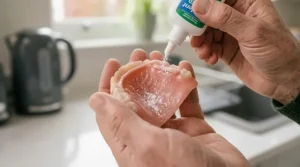
For powder: Start with clean, damp (not dripping wet) dentures. Hold the denture over a sink and sprinkle powder lightly and evenly across the gum-facing surface — you want a thin, complete coverage, not a pile in the middle. Shake off any excess. Press firmly in place and hold for several seconds, biting down gently. Crucially: use less than you think you need. A common first-use mistake is over-applying, which paradoxically weakens the hold as the powder has nowhere to expand. As guidance from Guy’s and St Thomas’ NHS Foundation Trust notes, proper cleaning of both dentures and gums forms the foundation of any adhesive working effectively.
For cream: Clean and dry your dentures first — cream bonds far better to a dry surface than a wet one. Apply small dots or short strips (never smear it uniformly) along the ridge and palate area. Rinse your mouth with water before inserting. Press firmly for 5–10 seconds. Then — and this is the step everyone skips — wait 15–30 minutes before eating or drinking anything. Give the adhesive time to set properly.
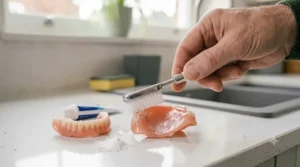
For both types: clean thoroughly at night with a denture brush and warm water. Leftover adhesive builds up, disrupts the fit, and reduces effectiveness over time. A clean denture each morning is the single most impactful thing you can do for adhesive performance.
UK User Profiles: Which Adhesive Suits Your Situation?
The best adhesive for a 75-year-old retired teacher in Harrogate isn’t necessarily the same as for a 58-year-old who runs a busy restaurant kitchen in Glasgow. Context matters here.
The first-time wearer (newly fitted, upper plate only): Start with powder. Fixodent Extra Hold or Corega Ultra gives excellent results on upper plates, cleans away easily at night, and helps you calibrate how much adhesive you actually need without the learning curve of cream dosing. You can always upgrade to cream later.
The confident long-term wearer (full upper and lower plates, active social life): Fixodent Dual Power or Poligrip Power Max. Lower dentures are harder to hold, and these cream formulas are specifically engineered for extended, multi-meal hold. The food-sealing properties matter considerably when you’re eating out regularly.
The partial denture wearer: Fixodent Dual Power is the standout here. Partial plates have an asymmetric load problem — natural teeth exert forces that can torque a partial plate loose — and the sustained-release formula handles this better than standard options.
The health-conscious buyer (concerned about zinc): Corega Ultra Adhesive Powder (zinc-free) or Poligrip Power Max (check current formulation). The NHS advises discussing zinc-containing adhesives with your dentist if you use them daily long-term, particularly if taking any zinc supplements.
The traveller / light user: PoliGrip Super Powder in its compact multipack format. Lightweight, clean, and doesn’t require the bathroom choreography of cream application.
Denture Adhesive Powder vs Cream: The Real Differences Nobody Talks About
The marketing materials for both formats promise an all-day hold and a confident smile. What they don’t mention are the practical daily realities.
Cleanup. This is where powder wins decisively. At the end of the day, powder residue rinses away with warm water and a soft brush — it leaves almost nothing to scrub. Cream adhesive, applied correctly, forms a seal against the gums that can take real effort to remove cleanly. Applied incorrectly (too much), it bonds to gum tissue with a tenacity that is impressive in the wrong context. The daily cleanup burden is genuinely lower with powder, and for anyone with arthritic hands or reduced dexterity, this isn’t a minor consideration.
Saliva interaction. Here’s a nuance the spec sheets skip over: powder adhesives rely on saliva to activate and swell. People with dry mouth conditions — common among older adults and as a side effect of many medications including antihistamines and antidepressants — may find powder performs inconsistently, because there simply isn’t enough moisture to activate the hold properly. Cream adhesives are less sensitive to ambient moisture levels, making them the more reliable choice for anyone managing dry mouth.
Cushioning. Cream provides a soft buffer layer between denture base and gum tissue. This matters — a lot — for anyone whose gums are sensitive, prone to soreness, or have thinned with age. Powder’s thinner adhesive layer is less forgiving on delicate tissue, and while it holds the denture in place, it doesn’t add the same comfort layer. Think of it as the difference between wearing shoes with and without insoles.
Upper vs lower plates. Upper full dentures benefit from atmospheric pressure — the palate creates a natural suction that assists any adhesive. Powder works brilliantly here. Lower dentures have no such assistance; they sit on a ridge that moves with every bite and word, in a pool of saliva, fighting gravity. Cream’s stronger cohesive bond generally wins for lower plates. This is arguably the single most useful piece of practical advice in this entire article.
✨ Check Out These Top Picks on Amazon.co.uk!
🔍 Whether you’re team powder or team cream, the products above are all available now. Click any highlighted item to see current pricing, delivery options, and verified UK buyer reviews.
Common Mistakes When Buying Denture Adhesive in the UK
Buying for the wrong plate type. As covered above: powder for upper plates, cream (generally) for lower. Buying based on a friend’s recommendation without considering whether you share the same denture configuration leads to disappointment.
Using adhesive to compensate for poor fit. This is worth stating clearly. Both the NHS dentures guidance and dental professionals are consistent on this point: adhesive should complement a well-fitting denture, not rescue a poorly fitting one. If you’re using enormous quantities of adhesive daily and still struggling, the denture needs adjusting or relining — not a stronger product. Adhesive cannot fix a denture that no longer fits your jaw.
Over-applying cream. The instinct when something isn’t holding well is to use more. With cream adhesive, this is almost always counterproductive. Excess cream oozes out from beneath the denture, tastes unpleasant, coats the gums, and actually reduces stability by preventing proper contact between denture base and tissue. More is genuinely less.
Ignoring zinc content for long-term use. Most standard cream adhesives (and some powders) contain zinc. Used as directed, this is considered safe. Used in excessive quantities daily for years — particularly by people also taking zinc supplements — it has been linked to neurological issues in documented medical cases. This is an edge case, not a daily concern, but it’s worth knowing. Zinc-free alternatives (Corega Ultra, Poligrip Power Max) exist and are widely available.
Skipping the dentist. Worth saying: denture adhesive is a convenience product, not a dental treatment. The NHS recommends regular check-ups even for full denture wearers, as jaw bone and gum tissue continue to change with age, affecting fit. A well-fitting denture needs minimal adhesive. If you’re using it constantly and generously, that’s a signal — not a solution.
How to Choose Denture Adhesive in the UK: 5 Key Criteria
- Upper or lower plate? Upper full plates: powder works excellently. Lower plates or partials: lean toward cream for maximum hold.
- Dry mouth or normal saliva production? Dry mouth sufferers should choose cream — powder needs moisture to activate and may underperform without it.
- Gum sensitivity? If your gums are tender, sore, or thin, cream’s cushioning layer adds meaningful comfort. Powder doesn’t provide this buffer.
- Daily routine and cleanup habits? If easy removal and quick cleanup matter (arthritis, limited dexterity, preference for simplicity), powder has a clear advantage.
- Zinc sensitivity or long-term health concerns? Opt for verified zinc-free formulations: Corega Ultra Adhesive Powder or Poligrip Power Max. Check current formulations before purchasing, as recipes can change.

FAQ
❓ Is denture adhesive powder better than cream for upper dentures?
❓ Can I use denture adhesive powder if I have a dry mouth?
❓ Does denture adhesive powder dissolve in saliva — and is that safe?
❓ Which UK denture adhesive is zinc-free?
❓ How long should denture adhesive last in a day — powder vs cream?
Conclusion
The denture adhesive powder vs cream debate doesn’t have a universal winner — which is frustrating, but also genuinely useful information. Powder is cleaner, simpler, and brilliantly effective for upper plates and lighter users. Cream holds more tenaciously, seals food out more effectively, and outperforms powder for lower dentures, dry-mouth wearers, and anyone who needs maximum confidence through a full day of eating and socialising.
For most UK buyers starting from scratch, the practical advice is this: try Fixodent Extra Hold Powder for upper plates, and Fixodent Complete or Poligrip Power Max Cream if your lower plate is the challenge. Zinc-free? Go Corega Ultra (powder) or Power Max (cream). Former Wernets devotee? Poligrip Ultra Wernets is still available — grab it while you can — with Corega Ultra as the closest ongoing alternative.
Above all, remember what both the NHS and dental professionals consistently emphasise: adhesive works best alongside a well-fitting denture, not instead of one. If you find yourself going through product faster than the instructions suggest, it’s worth a chat with your dentist about whether a reline might serve you better than a stronger glue.
✨ Ready to Find Your Perfect Fit?
🔍 All seven products reviewed above are available on Amazon.co.uk. Click any highlighted item to check current pricing, Prime delivery options, and UK customer reviews.
Recommended for You
- Best Denture Adhesive Powder UK 2026: 7 Top Picks Reviewed
- Fixodent vs Poligrip Cream: 7 Best Denture Adhesives UK (2026)
- Best Denture Adhesive Cream UK 2026: 7 Top Picks for All-Day Hold
Disclaimer: This article contains affiliate links. As an Amazon Associate, I earn from qualifying purchases. If you purchase products through these links, we may earn a small commission at no additional cost to you.
✨ Found this helpful? Share it with your mates! 💬🤗
